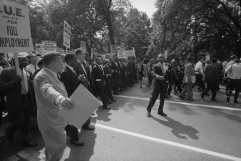
Rev Dr Martin Luther King Jr was assassinated on this day in 1968.
It was a personal tragedy for his family and his followers, and a political earthquake. It revealed, in case there was any doubt, the depths of the racial divisions that scarred American society – not just in the fact of his murder, but in the reactions to it, which ranged from grief to exultation.
His personal reputation, though, has only grown in the years since his death. His birthday (January 18) is a national holiday. In his commitment to equality, justice and peace he has become a moral lodestone to his country. He helps Americans define who they are.
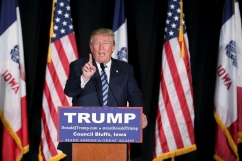
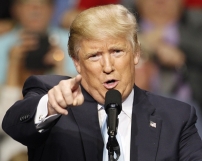
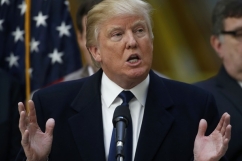
So what would he think of Donald Trump?
The Trump phenomenon is one that will keep political analysts in work long after the present election campaign, and – in the event of a couple of Trump presidential election victories – a long time after that. But one thing that's clear about it is that it's driven most of all by anger.
Trump's supporters are angry about something they can't quite define, but which they summarise as the loss of American 'greatness'.
To the rest of the world, this is baffling. A country with democratic institutions, a vast economy, a powerful military and a world leader in science, technology, entertainment, the arts – this is no longer a 'great' country?
But this is the narrative fed for decades by right-wing propagandists infuriated by changing social mores, the perceived failure of American arms in Iraq and Afghanistan, the intractable nature of conflicts elsewhere and – above all – by the economic stagnation of the middle classes. It's filled a vast reservoir of bile. Much of the anger is directed at President Obama, who has almost invariably responded with dignity and restraint, if at all.
But Trump has tapped into a much wider sense that all's not well with America, and he tells people exactly who to blame. It's mainly foreigners – Mexicans who send their rapists and thieves across the border, NATO countries that don't pay their fair share towards their own defence, China, which takes American jobs, and Muslims, who are terrorists. But it's also anyone who doesn't agree with him or share his analysis, such as it is. They are the enemy within. Hence the violence at his rallies as protesters are beaten up and ejected. Trump won't say he approves, but he condones it and his rhetoric encourages it.
Martin Luther King would have looked at Trump with horror and contempt.
King was no plaster saint. But he didn't preach hate. He was a Baptist minister with a profound awareness of God.
He said: "Darkness cannot drive out darkness: only light can do that. Hate cannot drive out hate: only love can do that."
Not all Trump supporters are haters. But his campaign feeds on hate. It encourages people to look for enemies outside themselves and blame all their problems on them.
King said: "We must come to see that the end we seek is a society at peace with itself, a society that can live with its conscience."
Trump's campaign isn't an appeal to unify society. It's an appeal to the worst kind of divisiveness.
King said: "People fail to get along because they fear each other; they fear each other because they don't know each other; they don't know each other because they have not communicated with each other."
Trump's campaign isn't about building bridges, it's about building walls. There's no need to understand your enemy. You just have to destroy him.
King said: "Rarely do we find men who willingly engage in hard, solid thinking. There is an almost universal quest for easy answers and half-baked solutions. Nothing pains some people more than having to think."
One of the most painful aspects of the Trump campaign for serious people has been the absence of thought in many of his policy statements. He plays to the gallery; he makes promises he knows will get applause, without troubling himself over whether they're sensible or deliverable.
What would Martin Luther King have thought of Donald Trump? Above all, perhaps, he would have been desperately disappointed. King consistently appealed to Americans' better natures. He called them to be more than they were. He was a preacher and he preached grace, but he also preached moral seriousness and the urgency of justice.
It's impossible to think of him voting for Trump. And that should give Americans pause. If they really value King's legacy, are they willing to tarnish it so blatantly?
Follow Mark Woods on Twitter: @RevMarkWoods