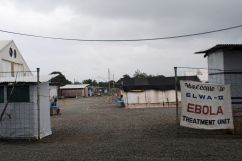
Mention Liberia and everyone thinks "Ebola".
Like other West African countries, Liberia suffered grievously because of the last epidemic. But though it was devastating, it was an episode in the nation's life. Something with the capacity to do more lasting damage – and even to cost more lives – has been fermenting among Liberia's political classes for the last year. Now the influential Liberia Council of Churches (LCC) has made a stand.
As part of the reconstruction process after its long-running civil wars, the government set up a Constitutional Review Committee (CRC), which met from 2012-15. In April last year it held a four-day conference out of which came a recommendation that Liberia – which is 85.5 per cent Christian – should become a Christian state.
The move had wide public support, including from among church leaders. It was also fiercely opposed by Muslims, who feared an upsurge in tensions, outbreaks of violence, the potential breakdown of Liberian civil society and even a return to murderous civil war. However, the LCC has rejected the plan. Bishop Jonathan Hart said earlier this week: "We strongly believe that furthering our collaboration and interfaith dialogue with all those united with us by faith and humanity will strengthen our harmonious relationship and create a peaceful society for mutual coexistence irrespective of race, creed, ethnicity or religion."
According to Front Page Africa, he said that "legitimising" religion in this way was to make it compulsory, and that wasn't what the church was for.
Whether the lawmakers who will have to decide this question will pay attention to the LCC's stance remains to be seen. But Liberia should be very grateful for the clearsightedness of its Christian leaders.
In England we have a Church established by law. That establishment arises from particular historical circumstances (the political need for an heir for Henry VIII, among other more worthy reasons). It has not always used its pre-eminence wisely or fairly, as Nonconformists and Roman Catholics remember, but nowadays, in general, it serves as an honest broker for Christians in general very well. Nevertheless, even in England, in a perfect world we wouldn't start from here.
The truth is that privileging one religion above another – and still less one denomination or branch of a religion – can't be justified anywhere, and particularly when religion is used as a marker of communal or ethnic identity. We see the results of this everywhere in the world today, as the Middle East burns, as other African countries labour under religious tensions, and as Hindus and Buddhists become increasingly assertive of their national prerogatives in India and Sri Lanka. Labelling Liberia, or any nation, as a "Christian country", is as much a mistake as attaching a Muslim label to Malaysia or Bangladesh. It isn't just that there are sizeable minorities in all these places that don't belong to the main religion. It is that the function of government is not to enforce a particular belief or practice, but to permit people to worship as they choose.
In many countries in today's world, this is not a view that's self-evidently true. If Islam is true, why shouldn't the government enforce it? If Christianity is true, why not enforce that? Tolerate other religions perhaps, but say your country is Christian.
But this a specious logic, that's undercut at three points.
First, we live in a globalised world in which the idea that cultures can be kept free from outside influences makes no sense. No society is hermetically sealed. Everyone drinks Coke and watches TV. Consequently, everyone's aware that there are alternatives to how they live now. Any government that tells its people who they are will have to backtrack before too long.
Second, there's the legacy of the Reformation. Slowly and painfully, the implications of Martin Luther's teachings became clear: that the individual had to make a personal response to the offer of salvation in Jesus Christ. The state is not involved, except insofar as it provides the conditions under which seeds of faith can grow. A Christian state is no more a sensible idea than a Christian teapot.
Third, there's the Bible. If the book of Revelation teaches us one thing, it's that the state is Babylon, not Jerusalem. It is, to a greater or lesser extent, corrupt and oppressive. It is not to be trusted, and Christians are not to feel entirely at home in it. Identifying any state with the will and purposes of God is dangerous. It leads us to justify the unjustifiable and defend the indefensible.
In the US at the moment – with feelings and rhetoric heightened by the forthcoming presidential election – there are many who want to claim that America is a 'Christian nation'. They were answered this week, bravely, by prominent evangelical leader Russell Moore, who said the idea was "really a form of theological liberalism. It assumes that a person or a nation can be a Christian apart from the regenerating work of the Holy Spirit, apart from new birth. That is contrary to the Gospel."
Religion and power don't mix. As Liberia's Christian leaders know, the best thing the Church could wish for is a secular state, in which its voice is heard and respected, but in which its hands are nowhere near the levers of power.
Follow Mark Woods on Twitter:@RevMarkWoods