When people can't admit their faith is complicit in violence

Some religious people do not find it easy to acknowledge that their faith could be complicit in violence, according to a leading expert in the field of interfaith dialogue.

Dr Clare Amos, of the World Council of Churches, told a symposium on Religion, Violence and Extremism  that it is important to remember that "religions don't have human rights, it is human beings that do".

She said some leaders of religious minorities, particularly in the Middle East, "may be more interested in the rights of the religious community they lead, to exist and carry out its official religious practices, than they are in the rights of particular individuals to profess any religious faith – or none".

She conceded that some people found it hard to accept aspects of their faith tradition.

Amos said: "There is a tendency to try and protect the religion itself from such an accusation by suggesting that those who commit acts of violence are not really authentic representatives of that particular faith tradition."

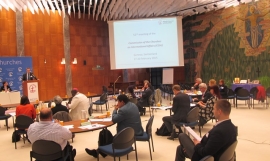
The event was run at the United Nations in New York by the World Council of Churches with the church and society board of the United Methodist Church and the Seventh-Day Adventists. The Network for Religious and Traditional Peacemakers was among the sponsors.

More than 130 delegates examined issues of violence, religion and where they crossed over.

Rudelmar Bueno de Faria, head of the WCC UN liaison office in New York, said: "Many participants emphasised the need to take into account the root causes of violence as a way of addressing the problem: economic and social issues, aspects related to marginalisation and exclusion, but also elements related to corruption and impunity."

He added: "We need to have a perspective of hope as opposite to fear."

Papers containing the main speeches are expected to be published soon. 

related articles
Religious violence is \'defining issue for our generation\', says Archbishop\'s representative
Religious violence is 'defining issue for our generation', says Archbishop's representative

Religious violence is 'defining issue for our generation', says Archbishop's representative

Syria: World Council of Churches calls for end to foreign interventions

Syria: World Council of Churches calls for end to foreign interventions

Refugee crisis is \'dehumanising\' victims, says Bishop Angaelos
Refugee crisis is 'dehumanising' victims, says Bishop Angaelos

Refugee crisis is 'dehumanising' victims, says Bishop Angaelos

Christians repent of their own sins as they agree to action on persecution

Christians repent of their own sins as they agree to action on persecution

Bishop Angaelos: The Church's silence has contributed to the decline of Christianity in the Middle East

Bishop Angaelos: The Church's silence has contributed to the decline of Christianity in the Middle East

News
A brief history of Christmas bans

These days, Christmas is hard to miss and nearly impossible to avoid. But at various times it has been banned in different countries, including Britain. This is the story …

Organisers of Christmas evangelistic campaign thrilled with impact

Organisers of this year's Shine Your Light Christmas evangelistic outreach have been "overwhelmed" by the response from local churches.

Reach out to others, says Salvation Army, as 1.8 million Brits set to spend Christmas Day alone

People are being urged to reach out after polling suggested 1.8 million UK adults will spend Christmas Day alone, even though they do not want to.

Another Christmas in hardship for Gaza church

For Christians sheltering in the Holy Family parish in Gaza, there will be few comforts this Christmas.