The Church of England's governing body may face a conservative rebellion over its discussions on gay marriage.
Despite pleas from senior bishops, a number of conservative Anglicans are considering boycotting the Church's private conversations over sexuality, designed to prevent a fracture over gay marriage. A deep fissure exists within the Church over whether or not to accomodate gay relationships in some way.
A memo sent round to some members of the Church's governing synod listed "reasons not to participate" in conversations, which aim to reconcile opposing factions. The note, seen by Christian Today, offers a damning assessment of the secret talks, known as "shared conversations".
A "dark cloud" also hung over the debate as questions were raised over how the £360,000 conversations were funded. A number of conservatives claimed the conversations were compromised because the liberal wing of the Anglican Church in the USA, which supports gay marriage, had allegedly paid for the talks in part.
The Church of England has undergone these private for conversations for the last two years at a local level. But from Sunday to Tuesday the Church's national governing body will enter talks behind closed in an effort to prevent a split.
A group of conservatives on synod will meet on Saturday morning to discuss whether or not they will boycott the talks. Susie Leafe, director of the evangelical bloc Reform, told Christian Today: "People aren't saying we can't talk about it. People are just saying we can't talk about it in a setup that is controlled." Reform had advised their supporters not to join in the Church's local versions of the talks and Leafe said it had not yet changed its guidance.
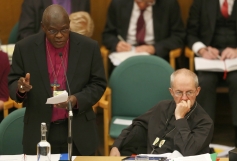
The numbers who will boycott the talks is not yet clear but a number of senior bishops today used their platform in synod to urge members to join in. The Archbishop of York, John Sentamu, highlighted a Church document "which says we must listen to the experience of homosexual people. How can we do that without shared conversations?" he said. "As a Church we must have a maturity of listening."
The Bishop of Willesden, Pete Broadbent, told the synod chamber: "If you are thinking of boycotting the conversations because they will compromise you in some way then I would say we particularly need to hear your voice."
But the memo circulated objected to the whole approach of conversations because it has meant the issue of human sexuality is seen as an issue Christians can agree to disagree on – a point some conservatives contest.
The note states that by joining in the conversations, conservative Anglicans could lose the ability to give an alternative position.
Andrea Williams, a member of synod considering boycotting the talks, said they had been "manipulated".
She told Christian Today: "The resolution [from the conversations] is that there will be no resolution." She said she began the conversations under the impression a decision would be reached but "suddenly the message from the platform is it won't be resolved".
She said marriage is "the heart of the gospel issue" and added: "The message is we are on this journey together and there may be no destination but we're journeying together.
"After all this and hundreds of thousands of pounds the Church will be no clearer."
Debbie Buggs, another member of synod considering boycotting, told Christian Today: "If someone disagrees with the Church's position on something you don't spend £360,000 talking about it. You have a one-on-one chat and you work it through."
Christian Today contacted the Church of England but no comment was available at the time of publishing.