Venezuela's new legislative superbody removed the country's chief prosecutor and ordered her to stand trial in its first session on Saturday, confirming opposition fears that it would use its powers to root out critics of President Nicolas Maduro. The prosecutor, Luisa Ortega, had become Maduro's main challenger from within the ruling socialist movement since the start of opposition street protests in April, which have left more than 120 people dead as rock-throwing protesters were met by state security forces firing rubber bullets and water cannon.
Ortega accused Maduro of human rights abuses and of fudging the results of last weekend's election of the new 545-member constituent assembly. The opposition, in control of the country's traditional congress, boycotted the vote, meaning that all candidates for the new body were Maduro allies.
His loyalist Supreme Court sent a letter to the assembly announcing its indictment of Ortega, accusing her of "alleged commission of serious misconduct", without providing details.
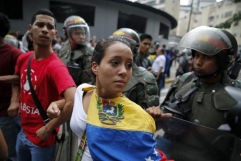
Ortega's office was blocked by armed National Guardsmen. She said she was roughed up as she tried to enter the building, claiming that one guardsman hit her with his body shield. Ortega ended up fleeing the chaos on a motor bike.
By sunset the scene had calmed but the National Guard kept access to the street in front of the building blocked. A half block away a colourful street mural was painted on a wall saying "The Constituent Assembly Will Go Forward."
"The firing of Chief Prosecutor Luisa Ortega is the first dictatorial act of an illegitimate constituent assembly. We reiterate our solidarity with the Venezuelan people," Juan Manuel Santos, president of neighbouring Colombia, said on Twitter.
Chile's leader Michelle Bachelet called Ortega's firing another step in Venezuela's "democratic breakdown". Washington singled out Maduro for financial sanctions last week and Pope Francis urged him not to inaugurate the divisive new body.
Venezuela's chief prosecutor Luisa Ortega Diaz is seen in front of the Public prosecutor's office in Caracas, Venezuela August 5, 2017.
South American trade bloc Mercosur indefinitely suspended Venezuela, adding to international pressure on Maduro to dismantle the newly created assembly and restore democracy. The assembly passed a resolution "emphatically rejecting" Mercosur's action.
The constituent assembly replaced Ortega with Maduro's human rights ombudsman, Tarek Saab, a government ally who the opposition says has turned a blind eye to state abuses.
After taking his oath as prosecutor, Saab vowed to stop violence against security forces and Maduro loyalists. He slammed Ortega for what he called her "complicity and inaction" in the face of the bloodshed that has occurred in recent months.
The new legislative body has no checks on its powers, and critics say the decision to remove Ortega is an ominous sign of a swerve by Maduro into full-blown dictatorship.
Critics blame Maduro's state-centric policies for pushing Venezuela into an economic crisis marked by triple digit inflation and severe shortages of food and medicine.
Maduro says the U.S. "empire" is waging economic war on Venezuela and refuses to allow humanitarian aid to enter the country. He says the new assembly is the only way to unify Venezuela into a peaceful, prosperous socialist state.
The assembly will function for up to two years, according to a resolution it passed on Saturday. The body's stated goal is to lock in the policies of late President Hugo Chavez, who put Venezuela on its socialist path when he was first elected nearly two decades ago.
It will hold is sessions in the same legislative complex as the traditional congress, which could potentially be dissolved. For now, the two bodies are set to hold sessions in parallel, separated by an ornate cobblestone courtyard.
Authorities on Saturday returned opposition leader Leopoldo Lopez to his home, his wife tweeted, where he is serving house arrest for his role in leading anti-government protests in 2014.
Lopez had been taken to a military prison on Tuesday after having been granted house arrest in July.