Over a thousand Roman Catholic priests have voiced opposition to same-sex marriage legislation in an open letter.
They warn in the letter, published in the Daily Telegraph, that their freedom to practise and speak publicly about their faith will be "severely limited" by the legalisation of gay marriage.
The priests fear a return to persecution and say that Government reassurances of protection for churches and Christians are "meaningless".
The priests write: "After centuries of persecution, Catholics have, in recent times, been able to be members of the professions and participate fully in the life of this country.
"Legislation for same sex marriage, should it be enacted, will have many legal consequences, severely restricting the ability of Catholics to teach the truth about marriage in their schools, charitable institutions or places of worship.
"It is meaningless to argue that Catholics and others may still teach their beliefs about marriage in schools and other arenas if they are also expected to uphold the opposite view at the same time."
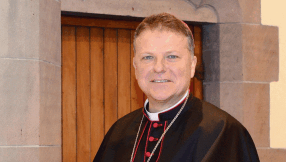
The 1,067 signatories include 13 bishops, among them the Bishop of Portsmouth the Right Reverend Philip Egan, the Bishop of Wrexham the Right Reverend Peter Brignall, and the Bishop of Nottingham the Right Reverend Malcolm McMahon.
The head of the Roman Catholic Church in England and Wales, Archbishop Vincent Nichols recently attacked plans to legalise gay marriage.
He said the plans were a "shambles" and that the Government had no mandage to change the law on marriage.
He also used a Christmas sermon to defend the traditional definition of marriage, saying that governments were "mistakenly" promoting sexual expression "without the public bond of the faithfulness of marriage and its ordering to new life".
The Government announced last December that it plans to introduce same-sex marriage before the next general election in 2015.
The Coalition for Marriage, defending the traditional definition of marriage, has launched a campaign to win support from 65 wavering or marginal MPs.
A million leaflets are being sent out urging voters to contact their MPs over the plans.
A petition set up by the group opposing the legalisation of gay marriage has attracted over 600,000 signatures.
Coalition for Marriage campaign director, Colin Hart said the Government's gay marriage proposals were "undemocratic" and showed that the Government was "out of touch" with ordinary men and women.
He said: "MPs should expect their local voters to press them on where they stand on the redefinition of marriage and why the leaders of the three main parties continue to make this a top priority when poll after poll shows that the policy does not enjoy popular support and voters don't believe the PMs motives on introducing the changes."