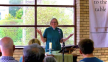
Math academic and apologist professor John Lennox has set his mind on stepping-up training for the next generation of young Christians called to engage with the world through apologetics.
Lennox, 80, known for his public debates with atheists such as Richard Dawkins, Peter Singer and the late Christopher Hitchens — who once conceded defeat after a debate — has recently taken on the mantle of presidency at the Oxford Centre for Christian Apologetics (OCCA).
Lennox wrote to his supporters in June after "a very long time" sharing "some significant updates in my journey and ministry."
He and his wife, Sally, have endured health challenges but said "although there have been some challenging weeks we are both feeling refreshed."
Lennox confirmed that in the past two years he has taken on the role of president at OCCA based in Oxford.
"This position is both an honour and a humbling responsibility," he said. "I am eager to mentor and help equip the next generation of evangelist-apologists to defend and communicate the Christian faith effectively."
OCCA is a training body offering a wide range of courses helping people grapple with the truths of following Jesus and how to answer questions related to issues of the Christian faith.
Lennox pledged to keep "in better contact" with his supporters whose encouragement have been "a great source of strength and inspiration to [my wife] Sally and me."
The academic has enjoyed an illustrious career and written many books helping the wider public see the rational balance between faith and science, such as Cosmic Chemistry: Do God and Science Mix? and 2084: Artificial Intelligence and the Future of Humanity.
Lennox has lectured at public events, often in academic settings, in Europe, North America and Australia. He is an emeritus professor of mathematics at Oxford University and an emeritus fellow of Green Templeton College, Oxford University. He is also a senior fellow of the Trinity Forum and recently wrote a biblical exposition, titled "Friend of God: The Inspiration of Abraham in an Age of Doubt."
As a student himself at the University of Oxford many years ago, he once saw Christian apologist, academic and author C.S. Lewis give a lecture, which he later described fondly in detail.
Students sat on the floor and all around the podium of the lecture hall, Lennox said, as Lewis would "burst in through the door" and start his lecture as he walked to the front, taking off his thick winter coat, scarf and hat.
"He just about divested himself of all his garments and he was at full blast and that continued for 50 minutes, and then he reversed the process and he kept lecturing, and his last word was uttered as he disappeared through the door. So that's my lasting memory of CS Lewis. There was no time for questions!"