World leaders of the Orthodox Church have spoken out in support of Christians and other persecuted minorities in the Middle East.
At the end of a week-long summit in Crete, Greece, the Orthodox bishops and patriarchs said: "The oil of religious experience must be used to heal wounds and not to rekindle the fire of military conflicts.
"The Orthodox Church unequivocally condemns the extension of military violence, persecutions, the expulsion and murder of members of religious minorities, forced conversions, the trafficking of refugees, the abductions, torture and abhorrent executions.
"She denounces the destruction of churches, religious symbols and cultural monuments. Very particularly, she expresses her deep concern about the situation of Christians and of all the persecuted minorities in the Middle East.
"She calls on the governments in the region to protect the indigenous Orthodox and other Christians and all the populations who have an inalienable right to remain in their countries as citizens with equal rights. Our Council appeals to all parties involved to make systematic efforts without delay to bring to an end the military conflicts in the Middle East and wherever armed hostilities persist and to enable all those displaced to return to their homes."
The bishops emphasised the call to convert, saying: "The re-evangelisation of God's people in modern, secularised societies and the evangelisation of those who have still not come to know Christ remain an unceasing obligation for the Church."
They also committed to dialogue with other Churches: "In this way the remainder of the Christian world comes to know more precisely the authenticity of the Orthodox Tradition, the value of patristic teaching and the liturgical life and faith of the Orthodox."
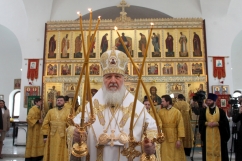
The Holy and Great Council was marred by the kinds of splits that have been a feature of Christianity for two millennia.
The meeting was led by Ecumenical Patriarch Bartholomew I of Constantinople, a prelate who has forged close links with other church leaders worldwide including the Archbishop of Canterbury and Pope Francis.
But four of the 14 national Orthodox churches that had been expected decided to boycott the Pan-Orthodox Council which ended yesterday. This was considered a disappointment given that a key priority of the council was to proclaim the unity of the Orthodox Church.
They were the Russian Orthodox Church, the Georgian and Bulgarian Orthodox Churches and the Greek Orthodox Patriarchate of Antioch and All the East. Patriarch Kirill of Russia, whose church alone is nearly twice the size of the 70 million strong worldwide Anglican Communion, complained that preparations had been inadequate.
It is hoped the council will take place from now on every six or seven years.