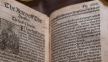
The handwriting of Martin Luther has been discovered on a pamphlet at Emory University in Atlanta dating from 1520.
Pitts Theology Library at Emory University's Candler School of Theology is home to the largest collection Lutheran works in all of North America. Until now, the collection only featured one other example of Luther's handwriting.
The discovery of this second example of Luther's handwriting was made possible by the library's digital archiving system. Ulrich Bubenheimer, a retired German professor, came across the new example of Luther's handwriting as he was working with a printed bibliography in Pitts Library's Richard C Kessler Reformation Collection.
The three-line text features on the title page of a 1520 pamphlet.
'Our immediate reaction was excitement,' said Bo Adams, interim director of the Pitts Library. 'We immediately wanted to verify the claim with advisers of the Kessler Collection, which we did.'
Bubenheimer was working with the print bibliography, which includes images of the title pages of a number of Kessler works. Upon seeing the inscription, Bubenheimer suspected it was Luther's handwriting and went on to email the library immediately.
'With the ease of digitisation and dissemination, we were able to send Professor Bubenheimer higher resolution images, which he was then able to use to confirm his initial assessment,' said Adams.
'I would like to inform you that the hand-written inscriptions on the title page are a previously unknown Luther autograph and that all three lines are written in Luther's own hand,' wrote Bubenheimer. 'With the identification of the inscriber, your library has been enriched by a Luther autograph,' he added.
The work is a dialogue mocking the Pope's decision to excommunicate Luther. In the text, Luther identifies its author as one of his companions.
As the Pitts Theology Library is no longer limited to issuing print versions of such rare 16th century documents, experts from around the world, such as Bubenheimer, can access its collection more easily.
'This particular episode provides further impetus for us to increase our digitisation efforts so that the treasures of the Kessler Reformation Collection can be available to researchers, teachers and students around the world,' said Adams.