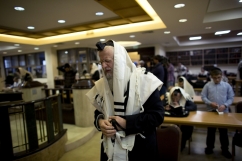
Yesterday two Palestinians from the historically Jordanian and Arab area of East Jerusalem murdered in cold blood four Orthodox Jews who, according to local news reports, were all rabbis living in the same street in the highly religious community of Har Nof in western Jerusalem. The Jewish men, one of them with dual British and Israeli citizenship, were attending morning prayers at the Har Nof Synagogue when the Arabs simply walked in unchecked and proceeded methodically to hack them to death. The Palestinians seem to have been intent on dying. They apparently made no attempt to escape the scene, and engaged with more bravado than sense in an obviously unequal exchange of gunfire that led to their deaths. This bears the hallmarks of an utterly brutal suicide mission against innocent Jewish members of the public.
British news coverage of the event has reinforced this impression by including an interview with a female relative of the British man, Abraham Goldberg. She condemned, and surely rightly, the senseless evil of the killings. She described her own experience of Israel as a tolerant society in which Jews have long co-existed in peace with their Arab neighbours. Consequently, she identified the current problem as one in which Arab extremists aim to destabilise Israel. Yet at almost the same moment, the Palestinian president publicly condemned the murders in almost the same language but laid the blame wholly at the door of the current Israeli leader, Benyamin Netanyahu. Abbas accused him of repeatedly provoking mutual hostility between Arabs and Jews and so of being responsible for the Jewish as well as Arab fatalities that have since occurred. What, then, is the truth? Here are some points of fact that help to explain this dreadful event.
Firstly, this was not an indiscriminate attack on Jews by some Arab fellow-citizens but a deliberate one on a particular kind of Jew (Ultra-Orthodox) by a particular kind of Arab (stateless Palestinians from East Jerusalem). What difference does that make? East Jerusalem is being colonised by such Orthodox families in a determined attempt to displace its Arab population and character. Their legal right to do so is denied in international law but they are doing it anyway. Conversely, the similarly recognised rights of Arabs in East Jerusalem have been systematically ignored.
Second, this event hasn't happened in isolation. It belongs within a chain reaching back directly to the abduction and murder of three Jewish teenagers last year and a subsequent Jewish revenge killing. Other attacks have followed, some minor and a few deadly. Recently, a toxic new element has recently been introduced concerning the Temple Mount.
For Jews it is sacred as the site of the biblical Temple. For Muslims, it is their third most sacred place associated with a miraculous event in the life of Mohammed. For many centuries, this conflict of interest has not mattered because, while Muslims have used it as a place of prayer since the earliest Islamic period, Jews have regarded it for even longer as a forbidden place for prayer until the Messiah comes to rebuild the Temple and re-institute its worship. In recent years, however, a small group is seeking to re-establish Jewish worship there and, some hope, to rebuild the Temple. The Israeli authorities are against it. They have enough political fires to fight already in the Middle East, but Arab rumours abound that they are liars. Netanyahu made a gross error of judgement, therefore, in responding to Palestinian hostilities by temporarily closing the Temple Mount to Muslims. It was interpreted as a step towards reclaiming the area for Judaism. That has brought the religious pot to the boil in Jerusalem. The targeting of Ultra-Orthodox rabbis was sadly predictable for the religious leaders associated with taking East Jerusalem, and perhaps the Temple Mount, out of Palestinian hands.
So many facets of this event are complex and incapable of certain proof, but two simple realities are not. Israel has a right to exist in security and peace, and so do the Palestinians. Either there must be reconciliation or there will in the end be mutual destruction. Thousands have died and perhaps so will thousands more, but the one death that will end it all is the death of an ideal.
Rev Phil Hill is pastoral theologian at Wales Evangelical School of Theology