Pastor John Isaac and his wife have been working in the slum community of Vijayawada City for the last 10 years, sharing the Word with children and young people and doing what they can to give them a vision and a hope for the future grounded in the Christian faith.
Although India is now the fifth biggest economy in the world (per GDP), slums are still a reality and they are home to millions of people.
There are many government and church-based programmes trying to raise standards of living and lift people out of the grinding poverty that has blighted such areas for generations.
Pastor John and his wife see a spiritual gap, which they have been working to fill since they first started their work in 2016 - breaking the cycle of spiritual and emotional poverty.
This is connected to the reality of physical poverty. Although this is not universal across India, in the slum where Pastor Isaac ministers, some children still go out to work instead of finishing their education in school.
“Because of family poverty, the parents want their children to go to work at an early age. Some children in the slums can start working from as young as 10 years old, so the cycle of poverty is repeated for generations. The impact of poverty on education is a big issue,” he says.
Not surprisingly, the pressures of poverty take their toll on families. Family dysfunction and breakdown are common problems, leaving to single parent households. In some particularly sad cases, mothers turn to prostitution to make ends meet.
“Some parents don’t care about their children, and this creates wounds in the children. They feel hopeless because of that,” says Pastor John.
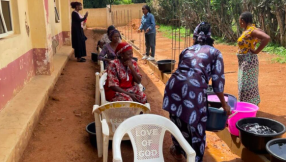
Given that the streets are a popular hangout for children living in the slums, this is where much of Pastor John’s ministry lies. Together with his wife they go out and organise simple activities for the children, like singing Christian songs together and hearing the Gospel. Other times, they gather in a church building. As many as 100 children might gather and Pastor John estimates that around 70 per cent of those who come are non-Christians.
Much of the couple’s work is simply speaking to the children about God and the Christian faith, providing a listening ear, and trying to steer them through any problems they are having at home or in school.
Sometimes that simple work has been life-saving. One time they saw a young girl crying and distressed on the street because her mother was drunk and had gone off with two men. When they spoke to her, she told them her mother did this every day. So they comforted her and prayed with her, reassuring her that God was with her.
“We told her that even if you don’t have a mother or father, God is there for you. Even if your mother is doing all kinds of things, Jesus is there for you. As we prayed for her, peace came into her heart and she could trust in God that everything was going to be okay,” says Pastor John.
When they had the chance, they spoke to her mother and pleaded with her to stop what she was doing for the sake of her daughter. After some time, they were able to get through to her and she accepted Jesus as her Saviour, and the relationship with her daughter was restored.
With high levels of poverty in the slums and spanning generations of their own families, it can be hard for some young people to imagine a bright future for themselves. In another harrowing case, Pastor John recalled a time when he and his wife had to talk a teenage girl out of suicide. She had no parents and was living with extended family but the environment was abusive and she was so miserable that she had lost all hope and just wanted to die.
“We shared the Word with her and prayed for her because we ourselves are not the ones who can bring healing," he says.
"Only God can bring healing into someone’s life. So we prayed for her and the Holy Spirit touched her and gave her hope in Jesus and she no longer wanted to die. Instead of wanting to die, she wanted to see how her life would be transformed by the Lord.”
Pastor John and his wife continued to counsel her and nurture her spiritually, guiding her to pray and read the Word every day, and connecting her with a church. Their relationship with her has continued over many years and today she herself volunteers with them, helping to counsel and mentor other children and young people in the slum. She is also a happily married mother with a young boy.
Amazingly, even many non-Christians in the area are appreciative of their work, says Pastor John. One time, when local police started giving them a hard time, even Muslim parents stood up for them.
“The police came and the Muslim families said no, no, no, these people have been here for years; they're not converting our family or children, they're teaching values. They're doing good within the families. So that's amazing,” he said.
One time, some Muslim parents even came and thanked them because they had seen such a difference in their children’s behaviour.
“They told us, 'Sometimes they don’t listen to us. We don't know what you shared with them, but they're obeying what we say now.' The encouragement they give is helping us to move forward in the ministry, even though we face challenges.”
As their own means are limited, the focus for Pastor John and his wife until now has been on providing simple activities and spiritual guidance to the children and young people in the slum. But their plan is to do more, starting with an afterschool programme to help children with their studies. Whatever comes next, the Isaacs are committed to long-term spiritual investment in their community.
“When we picture all of these young people in 10 years, we picture them as disciples and as godly leaders with godly character who can positively influence their communities,” says Pastor John.
“If we start with the root causes now, we can end this cycle of physical and spiritual poverty. That is my commitment to God.”