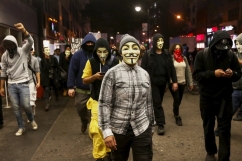
Hackers are widely perceived as individuals who take over or deface websites or social media accounts, oftentimes as a sign of protest to controversial issues.
In Ukraine, however, hackers have stepped up their offensive, cutting the power supply in parts of the country during the past holidays.
Ukraine's Ivano-Frankivsk region experienced a blackout for several hours last Dec. 23, which local media attributed to a virus that disconnected electrical substations from the grid.
John Hultquist, head of iSIGHT Partner's cyberespionage intelligence practice, told The Washington Post that this is the first time in history that hackers have employed this kind of attack, fuelling fears that digital attacks will begin to escalate.
"This is the first incident we know of where an attack caused a blackout. It's always been the scenario we've been worried about for years because it has ramifications across broad sectors," Hultquist told the newspaper.
The cyberespionage intelligence expert said that based on his firm's analysis of at least three regional operators affected by the blackout, the "destructive" cyberattack was caused by a malware.
This malware wiped files off computer systems, shutting them down and resulting in the blackout, he explained.
Moreover, Hultquist said the cyberattack was likely launched by a group iSIGHT called "Sandworm," which earlier targeted American energy sector firms and educational institutions, as well as government organisations in Ukraine, Poland and Western Europe.
He described the group as "Russian" but declined to elaborate.
"Operators who have previously targeted American and European sensitive systems look to have actually carried out a successful attack that turned the lights out," he said.
Tom Cross, chief technology officer at cybersecurity firm Drawbridge Networks, is also convinced that Russians are behind the cyberattack, but said this will be difficult to prove.
"It's easy to assume this threat actor is controlled by the Russian government and they intentionally shut down power in this region in Ukraine, but evidence to prove that conclusion is very difficult to obtain for various reasons," Cross also told The Washington Post.