Giant asteroid could hit and destroy Earth on April 13, 2036, Russian, U.S. scientists warn

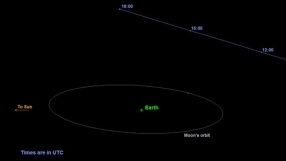
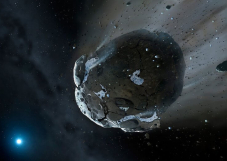
A NASA illustration of a doomsday asteroid striking Earth. (NASA)

A massive asteroid called Apophis could hit and destroy Earth on April 13, 2036, U.S. and Russian scientists have warned.

"There is a chance in 2036 [that Apophis will hit Earth]," Donald Yeomans, head of NASA's Near-Earth Object Program Office, recently told LiveScience.com.

The Russian news agency Sputnik earlier quoted Russian space scientist Leonid Sokolov from the St. Petersburg State University as saying that Apophis is likely to approach Earth at a distance of 37,000-38,000 kilometres in 2029.

Seven years later after that—on April 13, 2036—the asteroid may be on a collision course with our planet, he said.

"Our task is to consider various alternatives and develop scenarios and plans of action depending on the results of further observations of Apophis," Sokolov told Sputnik News.

The Russian scientists are basing their predictions of a collision on the chance that the 900-foot-long (270-metre) Apophis will travel through what's called a gravitational keyhole as it passes by Earth in 2029. The gravitational keyhole is a precise region in space, only slightly larger than the asteroid itself, in which the effect of Earth's gravity is such that it could tweak Apophis' path, the scientists say.

NASA was actually the first to announce in 2004 that there was a chance that Apophis, an asteroid larger than two football fields, could smash into Earth in 2029. Later, astronomers reduced the chance of a collision in 2029 to nearly zero.

"The situation is that in 2029, April 13, [Apophis] flies very close to the Earth, within five Earth radii, so that will be quite an event, but we've already ruled out the possibility of it hitting at that time," Yeomans told Life's Little Mysteries.

"On the other hand, if it goes through what we call a keyhole during that close Earth approach ... then it will indeed be perturbed just right so that it will come back and smack Earth on April 13, 2036," Yeomans said.

NASA said it will devise a scheme and machinery to reduce Apophis' chances of striking Earth to zero. Similarly, Russia's space agency also announced plans to prevent the giant asteroid from colliding with our planet.

Apophis was discovered in 2004, and was initially estimated to have a 2.7 percent chance of hitting Earth in 2029.

Space scientists continue to closely observe this asteroid at present using optical telescopes and radar systems.

related articles
Radar scientists to use Halloween asteroid to test new NASA imaging capability

Radar scientists to use Halloween asteroid to test new NASA imaging capability

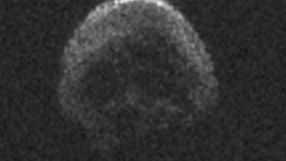
Dark dead comet looking like skull with empty eye sockets passes close to Earth on Halloween night

Dark dead comet looking like skull with empty eye sockets passes close to Earth on Halloween night

Mysterious metallic object crashing to Earth on Friday the 13th this month seen as sign of doom

Mysterious metallic object crashing to Earth on Friday the 13th this month seen as sign of doom

Extraterrestrial life more likely to be found in planets close to each other, says study

Extraterrestrial life more likely to be found in planets close to each other, says study

Massive asteroid on NASA high-priority list to zip past Earth on Christmas Eve

Massive asteroid on NASA high-priority list to zip past Earth on Christmas Eve

News
Richard Moth appointed as new Archbishop of Westminster

Bishop Richard Moth has been confirmed as the new Archbishop of Westminster, the most senior post in the Catholic Church in England and Wales. 

The mystery of the Wise Men

The carol assures us that “We three kings of Orient are…” and tells us they were “following yonder star”. Can we be sure there were three of them? Were they kings? Where in the Orient were they from? What was the star they followed? In fact, there is a lot that we just do not know. This is the story …

English Heritage deletes debunked claims about pagan origins of Christmas Day

English Heritage has admitted it got it wrong when it shared false claims that the date of Christmas is derived from a pagan Roman festival in honour of a sun god.

Guinness Book of Records recognises 'the world’s longest serving Sunday School teacher'

Pam Knowles started helping out her church Sunday school in 1951 at the age of 13.