Massive asteroid on NASA high-priority list to zip past Earth on Christmas Eve

On Christmas Eve this year, Santa Claus and his reindeers will not be the only ones flying in the night sky.

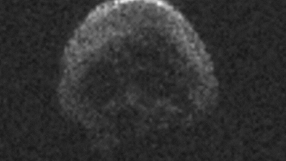
A massive asteroid measuring 1.5 miles in width is expected to make its closest contact on Earth this coming Dec. 24.

The gigantic celestial object, known as asteroid 163899 or 2003 SD220, has earlier been identified by the National Astronomical and Space Administration (NASA) as one of its 17 high-priority near-Earth asteroids due to its size.

The space agency has in fact been monitoring this asteroid using radars over the past months to determine just how close it will come in contact with our planet.

The asteroid will pass Earth from 6.7 million miles or 11 kilometres away. At this distance, the space object will be 28 times farther than the moon—way farther than the Halloween asteroid that flew by at 1.3 times the Earth-moon distance.

Some reports, however, suggested that the Christmas Eve asteroid will go to a distance so close to the Earth that it may cause destructive earthquakes on our planet. Space scientists, however, were quick to belie this claim.

Paul Chodas, manager of NASA's Near-Earth Object office at the Jet Propulsion Laboratory, said the asteroid has no "credible" chance of hitting and causing devastation on Earth.

"Again, there is no existing evidence that an asteroid or any other celestial object is on a trajectory that will impact Earth. In fact, not a single one of the known objects has any credible chance of hitting our planet over the next century," Chodas said, as quoted by UPI.com.

NASA Solar System Ambassador Eddie Irizarry also said that these claims of earthquakes being caused by the Christmas Eve asteroid have no scientific basis.

"Even if 2003 SD220 were passing closer, it's doubtful earthquakes would result. In fact, there's no scientific evidence that an asteroid's flyby can cause any seismic activity, unless it collides with Earth, but—in this case—that clearly will not be the case," Irizarry was quoted by The Daily Mail as saying.


related articles
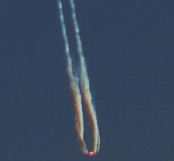
Mysterious metallic object crashing to Earth on Friday the 13th this month seen as sign of doom

Some religious conspiracy theorists are seeing the crashing of a space object called as "WT1190F," or simply "WTF," as a sign that the end of the world is near.

Pastor Carl Lentz says conflict between science and faith is a misconception

Faith and science seem to be polar opposites of one another, but Hillsong NYC senior pastor Carl Lentz believes that there is no conflict at all between the two.

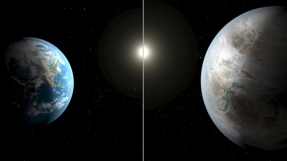
Extraterrestrial life more likely to be found in planets close to each other, says study

A paper written by astrophysicists Jason Steffen of the University of Nevada and Gongjie Li of Harvard's Center for Astrophysics stated that there is a higher likelihood to find alient life in planets very close together.

News
Historic Lancashire church awarded £614,000 towards restoration of Elizabethan ceiling

The money will go towards restoring its centuries-old Elizabethan ceiling and improve facilities for worshippers and the wider community.

Settler attacks in Taybeh leading to exodus of Christians

Taybeh has lost 10 per cent of its population in three years.

Questions raised about demolition of 19th century church in Manchester

Save Britain's Heritage has questioned the process behind the decision to call in the bulldozers.

Bishop raises plight of Christians caught in Sudanese civil war

Sudan has been in a state of civil war for most of its post-independence history.