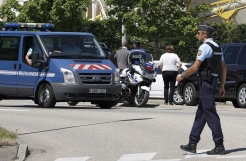
The suspected Islamist who attempted to blow up a French chemical plant on Friday has admitted killing his manager beforehand, a source close to the investigation said on Sunday, as police linked the suspect to a militant now in Syria.
Yassin Salhi, 35, told detectives he had killed Hervé Cornara in a parking area before arriving at the plant in Saint Quentin-Fallavier, 30 km (20 miles) south of Lyon, where he tried in vain to cause a major explosion.
Police found the 54-year-old victim's decapitated body and head, framed by Islamic inscriptions, at the plant, which is owned by the US firm Air Products. There were no other casualties.
Examination of one of Salhi's mobile phones revealed that he had taken a picture of himself with the severed head before his arrest and sent the image to a Canadian phone number. Canadian authorities said on Sunday they were assisting the investigation.
The phone number belongs to a French national, known by his first name Sebastien-Younes, who has been in Syria since last year, the same source said, confirming media reports. His last known location was the Islamic State stronghold of Raqqa.
According to other French media reports, Salhi told police he had argued with Cornara and with his own wife before the killing. One of their work colleagues, quoted on the website of the television station i-Tele, also said the two men had clashed days earlier after Salhi dropped a pallet of fragile equipment.
The suspect, whose wife and sister were released on Sunday after two days of questioning, is said by French security services to have associated with hardline Islamists over more than a decade, and had previously been flagged by them as a potential risk.
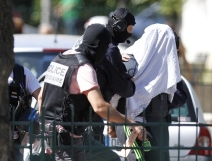
Flanked by heavily armed police in masks and flak jackets, Salhi was taken on Sunday to the car park where he said he had killed Cornara, before retracing the route he had followed to the chemical plant.
He was then escorted to the apartment he shared with his wife and three children in the quiet Lyon suburb of Saint-Priest, where further searches were carried out.
Earlier in the day, Prime Minister Manuel Valls said the government was increasing resources in law enforcement and domestic intelligence to combat Islamic extremism.
"We cannot lose this war, because it is essentially a war of civilization," Valls said in an interview broadcast on Europe 1radio and i-Tele. "It is our society, our civilization and our values that we must defend."