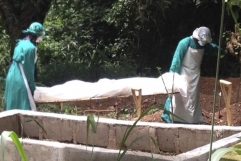
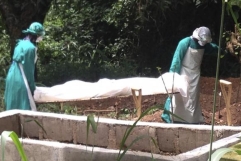
"We couldn't just sit back and watch Ebola engulf our country."
Matthew Brima is a wide-shouldered African and as we sit in a sweltering Mexican hotel lobby he wants to tell me what motivated him and his young students to try and make an impact in the middle of the world's biggest and most deadly Ebola outbreak.
Matthew is 37 and is the general Secretary of SLEFES (Sierra Leone Fellowship of Evangelical Students). He is an energetic man, full of enthusiasm and bursting with stories about what God is doing among students in his country.
The student movement has been running for 50 years and was pioneered by Christian graduates from Oxford University who came to lecture when the University of Sierra Leone was starting up. These graduates invited students into their homes for Bible study. Dr John Stott, one of evangelical Church's global leaders, was one of those who came over to the capital Freetown to help kickstart the movement.
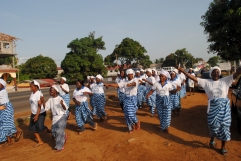
There are currently 34 tertiary education institutions in Sierra Leone and there are groups meeting on all of the campuses. The groups meet for Bible study, leadership training and campus evangelistic events and each group of students has specific projects to run. One campus group runs a summer school for children from rural communities and they teach a basic school curriculum.
Another campus group works on an integrity campaign, running seminars aimed at faculty and students on corruption and exam malpractice, and challenging the sex-for-grades practice present many campuses. Another group works on a UN backed programme which celebrates the "Day of the African child" – it mobilises students to get involved in relief and development work.
These projects involve students working together with SLEFES staff . I was impressed by the vision these student groups demonstrate and they show a level of innovation and social engagement I have yet to see in campus ministry in the UK and Europe.
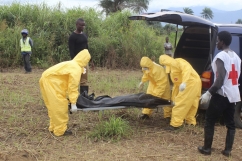
But the student ministry was taken to another level in May 2014 when the Ebola crisis erupted in Sierra Leone. The outbreak started at a time when a lot of students on campuses were taking exams and a lot of campuses had to close. Some students were stranded because of the quarantine and so SLEFES staff and students began to ask how they could help.
The first thing they decided to do was to pray and they set apart three days of prayer and fasting, gathering graduates, staff and students and even some university faculty from the three main universities. At the end of the prayer session there was a realisation that more that could be done. So the SLEFES team, which included medical doctors and students, organised a three-day workshop on an Ebola faith response.
Around 70 student leaders came together and this quickly led to an outreach and education programme. The students mapped out 12 vulnerable communities that needed hygiene and Ebola prevention training. Some of the students were scared to go, but felt they couldn't just sit back and allow Ebola to engulf their country.
Working in some of the slum areas on the outskirts of Freetown, the students ran seminars and training workshops. Medical students were included in each of the groups that went out, which included as well student engineers, economists and yes, theologians too. The residents engaged enthusiastically in the workshops as there was a lot of fear at this time. It helped to build trust that many of the students had family and relatives in the villages. Sierra Leone is an Islamic majority country, with around 65 per cent of the population identifying as Muslim. The Christian students were happy to offer their help and care irrespective of religious background.
Matthew explained how the work was recognised by the Ministry of Health as playing an important role in helping slow down the spread of the disease. The intervention opened many opportunities to share the gospel and build relationships with needy communities. The students themselves became more aware of the vulnerabilities of these slum communities and were exposed to issues around poverty and the lack of hygiene, and as a result students became more engaged in social justice.
At the end of August 2014, the news came through that Albert, one of the nursing students, had contracted Ebola . He was a volunteer staff worker with SLEFES. Matthew went to the treatment centre, which he describes as a very scary experience. But it exposed him to the needs of what people who had contracted Ebola. There were so many patients and the resources were so limited and yet there was chronic need among the patients for moral support and pastoral care.
Because of the strict quarantine it was difficult to bring hope to the sufferers. Matthew mobilised his students to get involved by setting up a phone support system offering help and encouragement to this student but they made it available to others.
They started a "Hope Alive" project, launching a radio programme and PA system at the government-run treatment centre in Freetown. It was so successful that the medical staff team started to use the system. Family members started to use the radio station to send messages to patients. The Ministry of Health commended the project and it received financial backing to be able to replicate its work in two other centres.
I asked Matthew why this was an important thing for the student ministry to do. "We are involved with the training of students to serve God in the market place," he said. "Until we help them relate to these issues they will not be able to make a difference in their work. Our students are not isolated, they are part of the wider community and they have family members that are in need. I see this as a vital of the discipleship process."
I find Matthew's approach to student ministry inspiring and refreshing, He models to his students a holistic form of ministry and an entrepreneurial spirit. The Ebola ministry was personally costly to Matthew as his cousin, her husband and two of their three children were killed by the disease. During the crisis
Matthew slept on the couch in his family home to avoid too much contact with his family for fear of infecting his baby daughter, and would be careful not to come into close contact with her for a week after he returned from the contamination zones.
The highlight of this difficult time was when because of his work Matthew was invited by the government to give out certificates of discharge to patients at the Ebloa treatment centre. One of those he got to give a certificate to was Albert, the medical student. Matthew is a big, strong man, but was not ashamed to tell me that this experience brought him to tears.
As 1,200 students and staff from 158 nations gather together at the International Fellowship of Evangelical Student's Quadrennial Global Assembly in Oaxtepec, Mexico, it is inspiring and encouraging to hear stories like these from around the world. Be encouraged: in the four quarters of the globe there is innovative and courageous ministry going on in university campuses.
Krish Kandiah is a contributing editor for Christian Today. He is attending the World Assembly of the International Fellowship of Evangelical Students in Mexico.