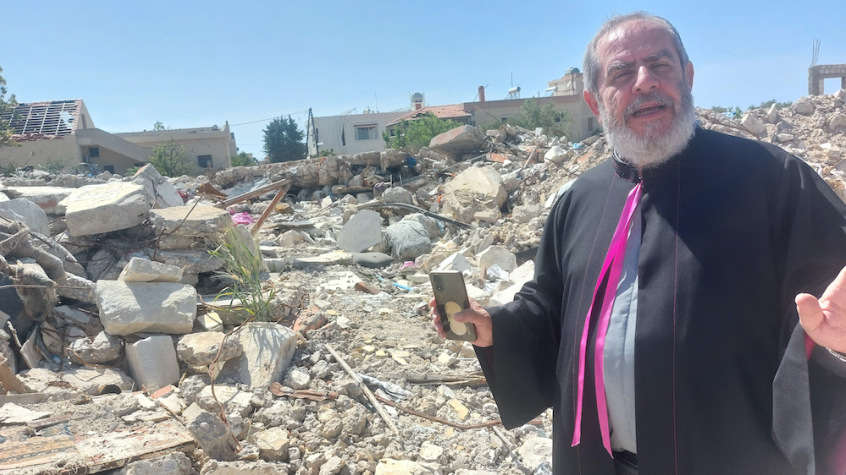
Christian families displaced by conflict in southern Lebanon are hoping that the olive harvest will mark an important step towards returning to their homes after more than six months away, according to Catholic charity Aid to the Church in Need (ACN).
Residents of Alma Al-Chaab, a Christian village near the Israeli border, remain scattered across Lebanon, unable to return permanently despite hopes of rebuilding their lives.
ACN reported that around ten farmers received permission from the Lebanese Army in September to clear overgrown land and tend to their olive groves.
The farmers were seeking further authorisation to harvest their crops, with the picking season expected to begin after mid-October.
Some olive groves and agricultural land in the region have been destroyed or severely damaged during the conflict, leaving farmers facing the challenge of restoring their livelihoods.
Maroun Ghafari, Maronite Chorbishop and the village’s parish priest, said the harvest represents more than an economic opportunity, offering families renewed hope of eventually returning home.
“If this stage succeeds, we will be moving along the path we hope to follow,” he told ACN.
During July and August, about 50 residents of Alma Al-Chaab were able to make brief visits to their village through supervised weekly convoys arranged with the involvement of local stakeholders and organisations including ACN.
However, the visits were bittersweet, with returning families confronted by the damage left behind.
“A smile and a tear reflect some of what we are enduring,” Fr Ghafari told ACN.
The priest estimates that around 100 residents are ready to return, although this depends on a political decision and access to essentials including food, medicine, drinking water, fuel and financial support.
Restrictions on movement could also complicate daily life, particularly during medical emergencies, prompting the parish to request a safe passage route.
Meanwhile, displaced families continue to struggle with mounting expenses, including rent, school fees, food and healthcare, while public assistance remains limited.
“Without divine providence, the displaced families would have died of hunger,” Fr Ghafari told ACN.
Despite the uncertainty, he said the community continues to draw strength from its Christian faith and shared commitment to returning home.
“Prayer in general … remains the strongest spiritual weapon for facing visible and invisible enemies,” he added.
The community’s displacement comes amid wider instability in southern Lebanon following renewed fighting between Israel and Hezbollah earlier this year.
Despite a ceasefire announced on June 20 2026, Israeli military operations and continuing security restrictions have prevented many residents from returning to their communities.
In September, the United Nations warned that renewed hostilities had deepened Lebanon's humanitarian crisis, with widespread displacement, damaged infrastructure and mounting economic hardship.
According to the International Organization for Migration (IOM), more than 333,000 people remained internally displaced as of September 9, while over 818,000 had begun returning to their areas of origin.