Millions of people visit cathedrals and historic churches in the UK and around the world every year. St Paul’s Cathedral and Westminster Abbey are among London’s most popular tourist attractions.
In many English cities, it’s the cathedral that tops the TripAdvisor list for ratings and reviews. Local churches that remain open through the week often find visitors drawn to them – to look around, pray, reflect, or simply pause amid busy lives. I call them our ‘invisible congregations’.
These visitors may not attend church services, but many are attracted to places of worship in search of something spiritual … maybe even something to which they cannot give a name. Perhaps they are seeking what St Paul might have called ‘the Unknown God’.
When the Bible Society’s Quiet Revival report was published last year, the headlines rightly focussed on the numbers of young people being drawn to church.
But, within the report’s pages was another, perhaps surprising, finding. It was that one of the top three places for people with no religion, or non-practising Christians to encounter the Bible was while sightseeing in a cathedral or church.
This underlines the importance of churches making available good printed material and displays explaining the Christian gospel.
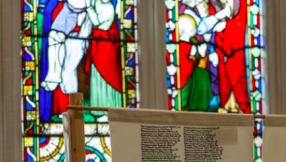
Yet it also may show the importance of a form of Christian communication that many modern-day evangelists may have ignored. The enduring appeal of stained glass.
Historian Janet Gough has recently produced ‘Divine Light’, a survey of some of the best stained glass in England’s cathedrals.
She explained, “The stained-glass windows of England’s cathedrals illuminate interior spaces, communicate religious, historical and political messages, and perhaps offer us a glimpse of heaven.”
Gough, a former director of cathedrals and church buildings for the Church of England, invited every cathedral, along with Westminster Abbey and St George’s Chapel, Windsor, to select one window to feature in her survey.
She looks at stained glass through the eyes of a historian, someone with a deep knowledge of church architecture and as a skilled Christian communicator. Her commentaries feature all three perspectives as she points out the story behind each installation.
Earlier examples of stained glass often depicted biblical scenes, illustrating scripture for those unable to read the accounts themselves. In this way, the cathedrals became ‘picture palaces,’ their windows telling the stories of Jesus, the Old Testament prophets, and the creation of the world.
In today’s society, dominated by the visual image – from Instagram to YouTube, TikTok and Facebook – these colourful windows could help introduce contemporary people to Bible narratives and gospel truths.
Much modern stained glass tends to be abstract, inviting viewers to engage their emotions and, perhaps, encounter awe in the presence of God. At Blackburn Cathedral, 56 panes of vibrant coloured glass depict the biblical theme of Christ as the Light of the World.
My local cathedral, St Albans in Hertfordshire, is represented by its striking Rose Window, dedicated by Diana, Princess of Wales, in 1989. Composed of 18,000 pieces of multi-coloured, hand-blown glass, it transforms throughout the day as the light shifts. The window makes an immediate impact on all who enter, helping visitors sense that they have stepped into a place of reverence and worship.
The window is one of my favourite features of the cathedral where I was ordained as a priest.
There is much biblical truth to be found in stained glass windows for those who look with an enquiring mind. In many cases, some knowledge of scripture may help decipher the stories being told.
In others, the viewer is invited into an encounter with the divine: to look in awe and wonder at the artistry, and to feel an emotional – perhaps spiritual – response to what they see.
Stained glass may not be viewed by many evangelicals as a powerful means of communicating the gospel. We often look to words rather than images.
Yet in our supremely visual age, these works of art – both ancient and modern – can capture the attention and imagination of the millions who are drawn to our cathedrals and historic churches.
Maybe we should pay stained glass more attention …
Rev Peter Crumpler is a Church of England minister in St Albans, Herts, and a former communications director with the CofE.