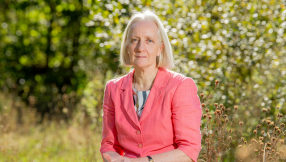
"It's about time that social media companies are held responsible for their content and are accountable for their actions," the Bishop of Gloucester, Rachel Treweek, has said after the Government unveiled plans to impose substantial fines on websites that fail to take action against "online harms".
The Department for Digital, Culture, Media and Sport (DCMS) outlined plans on Monday to create an independent watchdog responsible for ensuring websites follow a "code of practice" to protect vulnerable users.
The watchdog would hold websites accountable for breaches by imposing fines or blocking them, with individual executives also being held personally liable.
According to the proposals, websites will face action if they fail to block content such as child sex abuse, hate crimes, revenge p*rnography or terrorist propaganda.
Bishop Treweek, who has been campaigning for a safer online environment since 2016, said the plans were "an encouraging sign that the online world will start to be regulated to protect people like Molly Russell", the 14-year-old schoolgirl whose parents believe was influenced to take her own life after viewing images on depression and suicide on Instagram.
"It's about time that social media companies are held responsible for their content and are accountable for their actions," said Bishop Treweek.
"No other organisation in the 'real' world has that freedom. We manage to regulate electricity, water companies, broadcasters, shops etc through consumer bodies, yet for years social media companies have been allowed to self-regulate.
"These new clear standards, backed up by enforcement powers will hopefully be the step change to start really protecting our children and young people online."
Writing in the Telegraph today, the Bishop of St Albans, Alan Smith, said that the problem of harmful online content needed a global solution.
"There was a time when the global nature of the online world made it possible for people to shrug their shoulders and claim that regulation was impossible," he said.
"Now, with the tide turning, is the time to put that notion away forever: what we are seeing are global problems that require global solutions.
"We need an international treaty-level approach to defining the moral norms and standards for the online world, because like the sea, the waves of the internet wash up on every continent and we have to regard them as deserving of the same attention if we are to harvest their pearls as well as avoid the sharks."