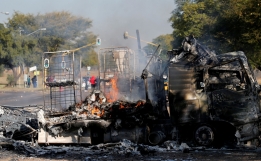
Church leaders in South Africa have appealed for calm as violence, intimidation and even assassinations marr the run-up to local elections next week, Anli Serfontein reports for the World Council of Churches.
Bishop Malusi Mpumlwana, in a statement from the South African Council of Churches, said: "Has our country descended to these low levels and becoming a mafia state? Let it not be so. God forbid! That is not the promise of South Africa; that is not the South Africa we pray for.
"Too many lives were lost in our struggle for democracy – and yet, even in sovereign freedom, killings continue, especially in the last few weeks."
South Africa's constitution guarantees freedom of political affiliation but as the municipal elections approach, there is a growing tendency among rival groups to mobilise protests that can have a destabilising effect.
The Church leaders said they were saddened by the "deadly phenomenon of political assassinations" driven by the "sin of greed and self-interest" that makes advancement by any and all means possible.
The value of human life is being disregarded, they claimed. "In the name of the Creator and Saviour God, we condemn this sin of greed and its murderous child," the Church leaders said, calling on local churches to intensify prayers and pastoral interventions.
Madipoane Masenya, Professor of Old Testament Studies at the University of South Africa, told Oikoumene: "In a nutshell, I think one would be unrealistic to expect a Church and religious leadership that did not grow out of a prophetic tradition, to start prophesying now towards a just society, especially now that the enemy is within us."
Dr Mary-Anne Plaatjies Van Huffel, of the General Synod of the Uniting Reformed Church in Southern Africa and a president of the World Council of Churches, said that during apartheid the media played a huge role in covering Church opposition, and therefore the perception was that the Churches played a large role.
Currently there is not the same will to cover what the Churches are saying. "The lack of media coverage led to the illusion that the Churches, faith communities and the SACC do not attend to socio-political and economic justice issues in post-apartheid South Africa," she said.