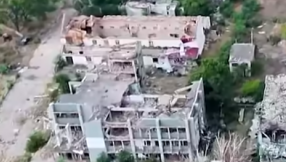
Most teenagers would normally be in bed asleep at 3am.
But this was just outside Mosul, and these two teens had got up early to teach themselves French and English and improve their Arabic. One of them had been in their first year of university when the fighting broke out.
This week in Amman, Jordan, Christian charity World Vision is partnering with Microsoft, Facebook, Google, Cisco and other big tech companies to try and bring a new approach to educating the many thousands of child refugees who have seen their futures sacrificed to war.
With classrooms, schools and homes bombed beyond repair, the tech companies and NGOs are looking at new ways to teach the kids the skills they need for adult life, using new apps on phones, tablets and laptops.
More than 630,000 registered refugees are in Jordan's capital Amman, just an hour from the Syria border.
So tech companies, motivated by altruism, have launched the #EdTech summit in a bid to inspire Syrian refugee children to harness the power of technology.
The UN estimates that the Syrian conflict – entering its seventh year this month – has set back Syrian children's education by 10 years.
World Vision, working with the Digital Opportunity Trust Lebanon and Lebanese Alternative Learning Alliance, has pioneered the Tabshoura e-learning programme for three-to-six year-olds. Using Moodle e-platform technology they have digitised the Lebanese school curriculum. A total of 2,350 educational activities include rhymes, short movies and flip books that can be accessed in Arabic, French and English for free.
The summit is part of the No Lost Generation campaign, which aims to give refugee children the education that the war has denied them.
Under half of Syria's primary school-aged children have access to a public primary school and under four per cent of teenagers have access to secondary school.
Lebanon and Jordan simply do not have the capacity to absorb these thousands of children into their state school system. World Vision believes that e-learning platforms can bridge the gap.
'Their classrooms have been bombed, their lives uprooted, and their chances in life potentially shattered as a result,' says world Vision.
Chris Weeks, of World Vision's Syria crisis response, told Christian Today: 'All the educational improvements made in last 10 years in Syria have been wiped out by the crisis. More than 1.7 million children inside Syria are out of school. A further 1.3 million more are at risk of dropping out. One in three schools in Syria is really badly damaged. It just means children aren't getting the education they need.
'This has massive knock-on effect on their future, the future of the economy and everything else. Classrooms have been destroyed or blown up. The children won't be able to go back to them. We have to find another way to get them an education, using digital solutions and apps which are mobile and can be used across borders.'
The vast majority of the refugees are Muslim. Aid is delivered on a needs basis only, and the children are desperate for an education.
Weeks said: 'My colleague was telling me about a family in Lebanon he met this Syrian family and the parents were missing a meal every day so they could afford to pay their kids bus fare to get to school. The desire is there. I was in Iraq 10 days ago in Mosul. Two teens came out of a tent. They were getting up at 3am every day to learn English, French and Arabic. There were bombs going off in the background. The older one had just started at university and had had to leave.'
While the immediate needs of refugees might seem obvious – food, clothes and shelter – if the people of war-torn Syria are ever to recover it depends on their children not just having their bodies fed, but their minds too. In a project like this, World Vision is laying vital groundwork for a hopeful future.