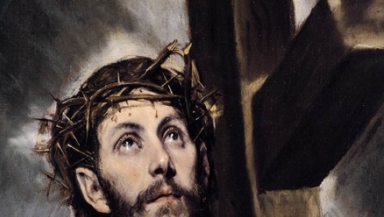
Thorn relic from Jesus Christ's 'crown' bleeds once again in another March 25 Good Friday miracle

Jesus Christ wears a crown of thorns as he carries the Cross in an oil painting made by El Greco in 1580. The painting is on exhibit at the Metropolitan Museum of Art in New York City. (Wikipedia)

It bled once again.

A single thorn believed to be part of the "crown" of thorns rammed on the head of Jesus Christ before He was crucified once again "bled"—a development that purportedly happens every time Good Friday falls on March 25.

Bishop Raffaele Calabro, Bishop Emeritus of Andria in Italy's Apulia region, confirmed on Friday that the thorn had started bleeding, the Catholic News Agency reported.

"The miracle has started, the wonder is underway," Bishop Calabro said.

The thorn has been kept in a reliquary, or a special container where religious relics are stored and displayed, in Andria's cathedral since 1308.

A commission that observed what is considered as a miracle confirmed that three spherical "gems" formed on the thorn and that "on the base of the thorn is the residue of the preceding miracle of 2005, renewing."

The last time the miracle of the bleeding thorn took place was in 2005. It is not expected to do so again until 2157. The occurrence has been recorded since 1633.

According to three of the canonical Gospels a crown of thorns was placed by Roman soldiers on the head of Jesus during the events leading up to His crucifixion. This was done to cause Him more pain and to mock his claim of authority. It is mentioned in the gospels of Matthew (27:29), Mark (15:17), and John (19:2, 5).

In later centuries, relics believed by many to be all or part of the Crown of Thorns have been venerated.

For Bishop Calabro, the miracle of the bleeding of the thorn is a gift from God and a sign of His love for mankind.

For Christians, the Crown of Thorns is a reminder that Jesus was, and is, indeed a king, according to biblical scholars.

Revelation 19:16 says: One day, the entire universe will bow to Jesus as the "King of kings and Lord of lords"

What the Roman soldiers did to mock Jesus led to a depiction of Christ's two roles—a suffering servant (Isaiah 53), and a conquering Messiah-King (Revelation 19).

Jesus was willing to endure the pain, the insults, and the shame, as part of God's plan to save mankind from sin.


related articles
How did Jesus die – and why? Understanding the Crucifixion

How did Jesus die – and why? Understanding the Crucifixion

Holy Saturday: Did Jesus descend into hell?

Holy Saturday: Did Jesus descend into hell?

The Ultimate Evidence: The Resurrection of Jesus Christ

The Ultimate Evidence: The Resurrection of Jesus Christ

Christians celebrating Easter Sunday on wrong day — ahead of Jesus\' crucifixion, pastor claims
Christians celebrating Easter Sunday on wrong day — ahead of Jesus' crucifixion, pastor claims

Christians celebrating Easter Sunday on wrong day — ahead of Jesus' crucifixion, pastor claims

J. Lee Grady: Christians should not settle for a 'sanitised' version of the Passion of Christ


J. Lee Grady: Christians should not settle for a 'sanitised' version of the Passion of Christ

News
New ‘Tyndale Trail’ launched to mark 500 years of English New Testament

A new long-distance walking route tracing the life of Bible translator William Tyndale has been launched in south-west England, as part of commemorations marking 500 years since his groundbreaking English New Testament.

Russia and Ukraine agree to temporary Orthodox Easter truce

In the Orthodox calendar, Easter falls one week after the date celebrated in western Europe.

Bishop urges people of Britain to stand up for Christian truth

It follows an earlier open letter addressed to King Charles, calling upon him to defend Christianity in line with his titles of Supreme Governor of the Church of England and "Defender of the Faith".

Fundraising Regulator reminds churches that collections are subject to code of practice

Churches can breach the code even when acting in good faith.