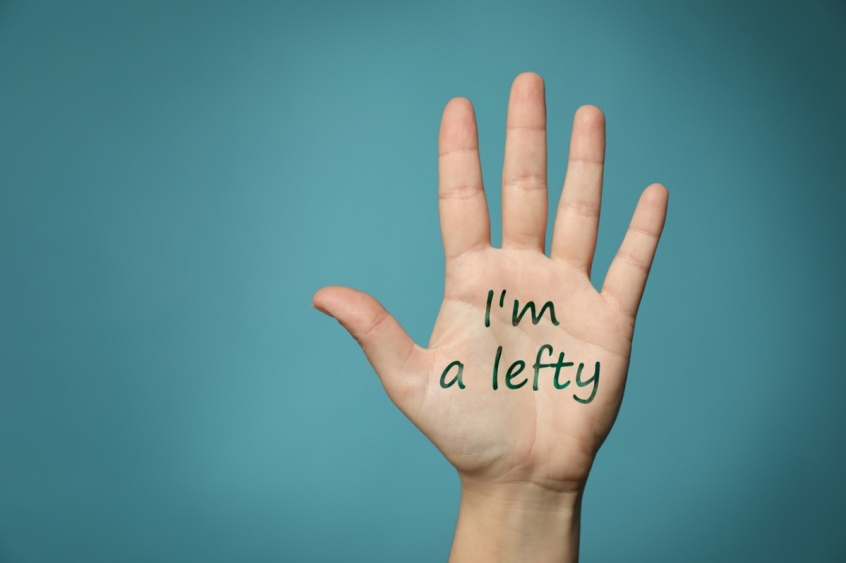
Sunday 13th August marked International Left-Handers Day, a day that might have easily gone unnoticed for most but held significance for those in the left-handed community.
Some church sermons briefly mentioned this celebration.
However, what was particularly striking over the weekend were some recollections appearing on social media message boards - where grown adults reflected on the stigma of their school days.
Unfortunately, these memories were often associated with Christian educational institutions, where being a minority left-handed pupil resulted in repeated shame, humiliation, and all too frequently, punishments.
Righteousness, the right path, to do the right thing ... It's easy to see how words can be used to galvanise and steer a belief. As easy, in fact, as black and white.
So, what led to the historical perspective that left-handedness was once considered wrong? Why did Christian religions show favouritism towards right-handedness?
In ancient societies, the right hand was synonymous with strength, while the left hand was regarded as weaker and less capable.
This perception was rooted in the dominance of right-handed individuals, leading to the erroneous assumption that left-handedness signified difference or even inferiority.
Ancient beliefs and religious symbolism further exacerbated the bias against left-handedness. The Latin word "sinistra," meaning "left," gave birth to the term "sinister," now synonymous with malevolence. Across cultures, the right side embodied righteousness and blessings, while the left was associated with superstitions and negativity.
Within the context of Christian religions, the preference for right-handedness gained prominence. The Bible often depicted the right hand as a symbol of divine favour, strength, and authority. This portrayal reinforced the notion that the right side held inherent virtues.
This bias permeated societal norms and educational systems. Left-handed individuals were coerced to adapt to right-handed practices, fostering feelings of alienation and potential psychological repercussions.
Conventional classroom arrangements favoured right-handed students, leaving their left-handed counterparts grappling with chalkboards, desks, and tools designed for right-handed use.
Scientific misconceptions also played a pivotal role in perpetuating this stigma. The concept of brain lateralisation, the specialisation of brain hemispheres, was widely misunderstood. Incorrectly, left-handedness was linked to a less developed or malfunctioning brain, solidifying the notion that being left-handed was "wrong."
The term "sinistra" acts as a poignant reminder of the deep-seated bias against left-handedness in historical and linguistic contexts.
While society has made strides, efforts to disband these stigmas are ongoing. Advances in genetics and brain research have dismantled numerous misconceptions, acknowledging left-handedness as a natural variation.
With the rise of advocacy groups and awareness campaigns, the negative perceptions surrounding left-handedness have begun to dissipate.
It's essential to acknowledge that the historical preference for right-handedness was rooted in the complex interplay of cultural, religious, and scientific factors.
By embracing diversity and dismantling myths, we pave the way for an inclusive and understanding society that celebrates the uniqueness of every individual, irrespective of their handedness.
Duncan Williams is outreach director for the Christian Free Press and has worked for Son Christian Media here in the UK and Recovery Network Radio in the United States. He is an ordained minister and a long-term member of Christians in Media. He provides content and syndicated news for regional publisher www.tindlenews.co.uk