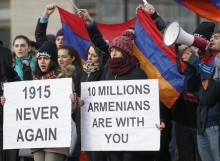
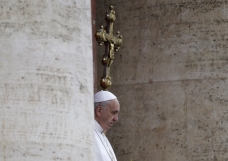
The deaths of up to 1.5 million Armenians under Ottoman rule constituted "the first genocide of the 20th century", Pope Francis said yesterday, in a statement that is likely to sour relations with Turkey.
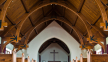
The pope was speaking at Sunday's Mass in the Armenian Catholic rite at Peter's Basilica, in a ceremony to honour the 100 year anniversary of the slaughter, the BBC reports.
Referring to crimes committed in the name of Nazism and under Stalin's rule, and in countries such as Cambodia, Burundi, Bosnia and Rwanda, "Concealing or denying evil is like allowing a wound to keep bleeding without bandaging it," Francis said. He added that he had a responsibility to honour those who were "senselessly" killed.
"It is necessary, and indeed a duty, to honour their memory, for whenever memory fades, it means that evil allows wounds to fester," he said. Though we remember "with hearts filled with pain", we at the same time have "great hope in the risen Christ".
There have been "three massive and unprecedented tragedies" in the past 100 years, he told those gathered, which included Armenian President Serzh Sargsyan and the Patriarch of the Armenian Catholic Church. "The first, which is widely considered 'the first genocide of the 20th Century', struck your own Armenian people."
"It seems that humanity is incapable of putting a halt to the shedding of innocent blood".
Though many countries formally recognise the genocide, Turkey has consistently disputed it. It accepts that many Armenians died in partisan fighting, but denies that the figure is as high as 1.5 million, and says that it did not amount to genocide. According to the Guardian, Turkey's embassy to the Holy See cancelled a press conference planned to take place today.
In his homily for Divine Mercy Sunday today, Vatican Radio reports that Francis alluded to the massacre of the Armenians once again, but focussed on the mercy of Christ.
"It is only Jesus, God made man, who died on the Cross and who fills the abyss of sin with the depth of His mercy," he said.
"Faced with the tragic events of human history we can feel crushed at times, asking ourselves, "Why?". Humanity's evil can appear in the world like an abyss, a great void: empty of love, empty of goodness, empty of life. And so we ask: how can we fill this abyss? For us it is impossible; only God can fill this emptiness that evil brings to our hearts and to human history.
"It is Jesus, God made man, who died on the Cross and who fills the abyss of sin with the depth of his mercy."
Speaking at an Armenian Catholic church in Rome earlier this week, the pope said it was time for countries to seek reconciliation over the events of a century ago.
"We invoke Divine Mercy to help us all, for love of truth and justice, to heal every wound and bring about concrete gestures of reconciliation and peace between nations that still have not been able to reach a reasonable consensus on the interpretation of these sad events," he said.