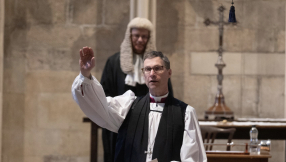
Former bishop Michael Nazir-Ali has criticised Britain's "naïve" approach to multiculturalism, which he said has led to a sense of "isolation" and "separateness" instead of integration.
Nazir-Ali, who came to Britain after fleeing persecution in Pakistan, said that there must be a greater emphasis on shared values, history, and traditions if Britain wants to achieve a more unified society.
Writing in The Telegraph in the wake of the riots, he argued that the violent unrest was caused in part by existing policies that have allowed communities "to maintain and nurture separate identities".
"This led to isolation from one another and, instead of mutual give-and-take and learning from one another, to suspicion, fear and sometimes downright hostility," he said.
Instead, Britain must adopt a more balanced immigration policy that takes into consideration social cohesion, "high worklessness" in some sections of the population, and the capacity of Britain's "creaking" infrastructure to absorb more people.
Nazir-Ali, who was formerly the Anglican Bishop of Rochester before converting to Catholicism, said that the failure to stop people arriving illegally in small boats has been "a significant drain" on Britain's economy and that the country has the "duty to consider the well-being of those already within its borders".
"We must continue to fulfil our moral and legal obligations to those who are genuine refugees. But Britain cannot be seen to have a monopoly on receiving refugees, especially those coming from safe countries. We need a new international agreement on nations accommodating refugees," he wrote.
Turning to integration, he suggested that in order to achieve true social cohesion, the population must have a "common memory" and "shared history", and that new arrivals to Britain must have "sympathy" for British traditions and values.
"If there is to be any hope of maintaining and enhancing social cohesion, those coming here to live and work should be required not only to have some knowledge of the English language but also of the history, beliefs and values which have formed British society. This can be strengthened as they prepare for citizenship," he said.
"Knowledge is one thing, sympathy is another. We should expect those wanting to live here to have sympathy for the country's history, traditions and values.
"Rather than the separateness encouraged by multiculturalist approaches, government policy should seek more than just a common language for social discourse. Housing policy, schools, community facilities and even higher education must all actively avoid ghettoisation and reward social mobility and the mixing of different communities."
He went on to say that more must be done to address the needs of economically, educationally and socially deprived indigenous Brits.
"There is no 'white privilege' here," he argued.
"Without addressing their needs, it is unlikely that we will be a society at ease with itself."