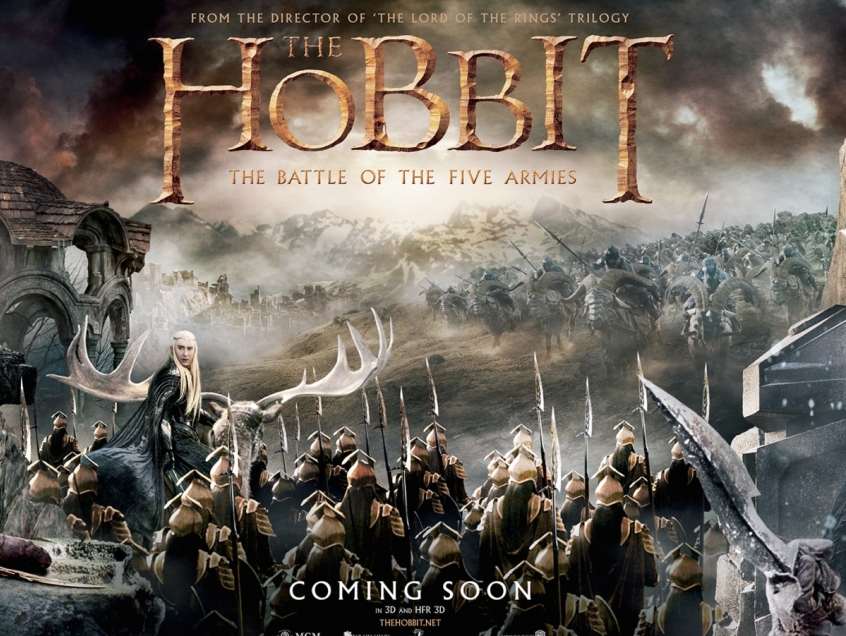
It's fair to say the movie version of The Hobbit has taken some flak, especially from fans of the original book classic by JRR Tolkien.
As part three gears up for release to theatres over the Christmas period, its makers are not shy about the fact they've made a few tweaks, and they think those tweaks are all positive.
A new character, the female elf warrior Tauriel, who does not appear in Tolkien's fantasy novel, turned up in the second Hobbit movie and is back in "The Hobbit: The Battle of the Five Armies".
The character played by Canadian Evangeline Lilly was created to give young girls a way into the overwhelmingly male-dominated plot, director Peter Jackson and screenwriter Philippa Boyens told Reuters.
"Now they'll know how to kill Orcs," Jackson joked in a joint interview with Boyens after the London world premiere.
"We have probably committed atrocities with the canon," said Boyens, who with Fran Walsh won an Oscar for best adapted screenplay for the last movie in "The Lord of the Rings" series, based on the trilogy Tolkien wrote after "The Hobbit".
She was responding to criticism from "Tolkien scholars", as well as reports that Tolkien's son Christopher, who edited his father's posthumously-published "The Silmarillion", the only one of Tolkien's Middle-earth fantasy books that has not been filmed, dislikes the movies.
"But there's two things to be said to that, really. One is we've brought an awful lot of people to these books and now they get to explore that.
"And second, Professor Tolkien himself said that he had created this mythology and he hoped other minds would come to it, because it's a myth, it's a living, breathing thing."
It may be a living myth, or perhaps a fire-breathing one, which is what the Benedict Cumberbatch-voiced dragon Smaug brings to the films, but Jackson sees little chance of making more Middle-earth movies beyond a director's "extended-cut".
He said the only contact he has had with Christopher Tolkien was when he started filming the "Lord of the Rings" trilogy 17 years ago, offering to meet "to say hi".
"He said, 'No, I don't want to meet you' and that's the first and last communication we've ever had with him," Jackson said, adding that some of Tolkien's grandchildren had nevertheless made cameo appearances in the films.
The six films he has made based on Tolkien's novels have been huge box-office successes, with the first grossing $1 billion worldwide. They are likely to stand as Jackson's legacy as a filmmaker, but like any director aged 53, he is hoping the best is yet to come.
He is set to direct the next in the "Adventures of Tintin" series, which was launched with a Steven Spielberg-directed film in 2011 based on the boy adventurer character created by the Belgian cartoonist who went by the name of Herge.
"Every time you make a movie it's like going to film school, so if I make a 'Tintin' film next year or the year after it will be a different movie to what I would have made before 'The Hobbit'," Jackson said.
"The best films of any director's career should be the ones just when he's old enough to be old but before he gets a little bit vague."
Source: Reuters