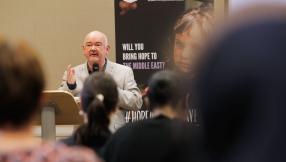
I've never been to Caesarea Philippi but it's a place I often return to when I read such sobering accounts of contemporary church life as the one recently outlined by Tom Holland. Holland believes that we are watching the effective extinction of of Christianity from its birthplace.
"In terms of the sheer scale of the hatreds and sectarian rivalries, we are witnessing something on the scale of horror of the European Thirty Years War," he says, all of which is but "the climax of a process grinding its way through the twentieth century".
Caesarea Philippi of course is the place where Jesus posed the most important question anyone will ever have to answer: "Who was (or is) He?" Peter, as was so often the case, was the first to open his mouth and respond with the breathtaking response that He was convinced that Jesus was the long awaited Jewish Messiah.
Jesus, as we know gave him ten out of ten for his answer but then went on to talk about the way in which he would be brutally murdered. This was not on Peter's agenda at all. And then, just as importantly he pointed out that even though he would build his church it would be often in the face of the most intense and bitter opposition.
Jesus did not underestimate the scale of the challenge or the danger facing his followers but He was convinced that nothing could stop his church growing. He was sure that no power on earth could stop his followers witnessing and nothing would prevent acknowledging Him as their rightful sovereign.
History has proved him right. We have all the evidence we need to show that "the gates of hell" cannot and will not prevail. Jesus was judicially murdered but He came back to life. The early church was persecuted terribly but within three hundred years it had become the official religion of the Roman Empire. And so it has continued.
But we need to take great care lest we end up with an over-simplistic understanding of persecution because there are times when it will seem that the opposition is winning. Indeed distinguished historian Philip Jenkins has gone so far as to suggest (and I would argue correctly) that we need a "theology of extinction". Everyone likes to read about church growth but hardly anyone spends time reading about those churches that are being killed off. But he is correct: Christianity can move from area to another. It can burst into new life in one part of the world but it can also die in areas where it was once vibrant and full of life.
We need to remember this. Jesus never said any particular church or group of churches would survive indefinitely. He said his church would succeed in spite of all the odds and all the dangers. He said his church would grow and it has – for two thousand years. But that does not mean that it might not all but disappear in some places.
And so we need not lose heart when we hear Tom Holland's distressing survey of church life in the Middle East. We need to listen very carefully to what Jesus said and then heed the lessons of history. And just as importantly we need to pray for those who are suffering in ways that few of us in the comfortable West can hardly imagine.