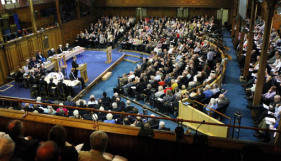
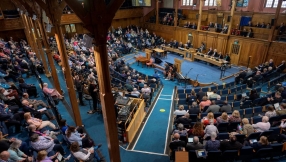
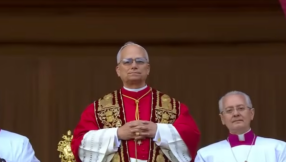
Attempts to remove religious education from Scottish schools must be defied, the Moderator of the General Assembly of the Church of Scotland has said in his New Year message.
The Rt Rev John Chalmers said education is the "frontline for winning" the battle against extremism.
"As we enter a new year there is probably no issue of any greater concern around the world than the rise of religious fundamentalism," he said.
"Nothing is more dangerous than the radicalised mind and there is nothing worse than the indoctrinated child. We will not, however, defeat such extremism simply by confronting it across battle lines. The frontline for winning this battle is education and the school is the place where young minds need to be introduced to the power of critical enquiry."
Chalmers added that while he is not advocating proselytising in schools, it is imperative to offer young people a well-rounded understanding of world faiths. He also said that he opposed the Time for Reflection - periods of religious observance in Scottish schools - becoming an optional activity.
"It has never been more important than it is now to maintain a proper, temperate and inclusive approach to the practise of religious observance," he said.
"Every child needs to know about religious practice and it has to be shared in a context of open-mindedness and mutual respect. So, I'll be doing all that I can to see that religious observance or time for reflection stays in the curriculum.
"I am comfortable with such an approach to religious freedom not least because God's encounter with each one of us depends on God's gracious meeting with us rather than our zealous encounter with others on God's behalf," he concluded.
However, Chalmers' address has been denounced by the Scottish Secular Society (SSS). Chair Spencer Fildes has accused the Moderator of "astonishing hypocrisy".
"On the one hand he doesn't want to impose his Christian views whilst imposing forced praying to God on children in so-called non-denominational schools," Fildes said in a statement.
"His Church has held a virtual monopoly on the propagating of his Christian religion for so long he appears to be unaware of it. The privileges of proselytising a purely Christian message are embedded in Scottish law which leaves him little room for manoeuvre if he wants to offer a "wide ranging menu of different ideas that populate the world." We would go further. Since Religious Observance is here to stay: Let us give an equal space to other religions. Let us see Imams brought into schools as we do Christian clerics. Let us see prayers given to Allah as we do to Jesus."
SSS Board member Robert Canning has backed Fildes' comments. He said that while he agrees that critical enquiry is vital in a well-rounded education, there is a significant distinction between religious observance and religious education, which Chalmers has ignored.
"The Scottish Secular Society support religious education when it consists of neutral comparative study of all major religions without any one being presented as the truth. Religious observance, however, all too often means children being made to pray and worship according to a single faith tradition - Christianity - and being presented with Christian beliefs as though they were fact," Canning said.
"The option of removing non-Christian children from this imposed Christian practice is almost worthless if parents are discouraged from using it by the prospect of their children being the first to be opted out and thus placed in isolation."
The Church of Scotland faced criticism earlier this year for partnering with the Scottish Humanist Society to propose a change in name for the period of Religious Observance - a statutory requirement for schools in Scotland - to 'Time for Reflection'.
The Church said it hoped to increase inclusivity and reflect the diversity of school children and their faiths, but was accused of "capitulating to the secularist agenda".
However, the Kirk said any suggestion that it wanted to remove religion from schools was "entirely without foundation". Chalmers' address is likely to quell these concerns once again.