The crisis in the Middle East is the "greatest humanitarian crisis since World War II", and the massacre of Christians, Yazidis and other religious minorities demands international action, a UN meeting heard yesterday.
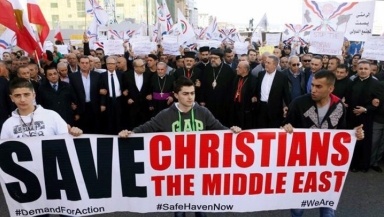
Speaking at a panel sponsored by the Holy See's permanent observer mission to the UN in New York on Thursday, Carl Anderson, head of the Knights of Columbus, said: "We face the very real prospect of the extinction of many of the communities indigenous to the region".
The panel was part of the #WeAreN2016 conference being held this week.
'N', or ن in Arabic, is a symbol that has been used by ISIS to identify who is a Nazarene – a Christian. It has been drawn on doorways and in front of houses in cities captured by militants.
"We have a unique opportunity to change things for the better," Anderson said, according to the Catholic News Agency.
"Never before has the world's attention been so focused on the suffering of these minorities. Never has their plight been so high on the agenda of the world's governments, the vast majority of the world's Muslims, and all people of good will."
In February, the European Parliament passed a motion unanimously declaring ISIS' atrocities genocide, and the US secretary of state John Kerry declared the jihadist group was "genocidal" in March.
In the UK, the House of Commons also voted unanimously last week to label ISIS' actions against Christians, Yazidis and other religious minorities as genocide. However the Conservative government refused to support the motion.
"The world stands at a crossroads. The rich tapestry of religious pluralism in the region must be preserved now or it will be lost forever," Anderson said, urging the UN to take action and refer ISIS to the International Criminal Court.
"If Christianity disappears in this region, so does the opportunity for pluralism there; and the likelihood of majoritarian theocracy, or something worse, is increased," he added.
"The threats from such an outcome to peace, stability and security – in the region and beyond – are substantial."