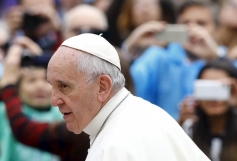
True Christianity means taking path of inclusion, not the opposite way which leads to war, says Pope Francis

Pope Francis on Thursday denounced modern-day Pharisees who are quick to judge other people and despise those who are not like them, saying the path they have chosen is "the root of all wars: all calamities."

Delivering his homily at the daily Mass in the chapel of St. Martha Guesthouse in Vatican City, the pope did not mention by name the specific groups or sectors he was referring to as he spoke in abstract terms about what true Christianity means.

"There are two paths in life: the path of exclusion of persons from our community and the path of inclusion," he said, according to a Catholic News Agency (CNA) article.

The path of exclusion is "the root of all wars: all calamities ... One is excluded from the international community, but also from families, from friends."

On the other hand, the path that brings people closer to Jesus and where true Christianity lies "is contrary to the other: to include," Pope Francis said.

He said to be selective "is not Christian," citing the day's first scripture reading from Romans in which St. Paul chastises those who look down on others.

The Pope castigated those who have the attitude of the Scribes and the Pharisees who regard themselves as perfect in their adherence of the law, while judging others they deem to be sinners.

Pope Francis pointed out that Jesus Christ sacrificed Himself on the cross to save all of mankind, not just a select group of people.

The pope admitted though that having an inclusive attitude is hard to do for some people because "there is that selective attitude" of resistance.

The head of the Roman Catholic Church then cited two parables in the Gospels—the parable of the lost sheep and that of the woman who lost her coin. Both the shepherd and the woman vowed to do anything if only they could regain what they lost. When they eventually found what they were looking for, they were filled with joy. Because they felt joy in their heart, they wanted to express this feeling to other people so they went to their neighbours, their friends to share with them the good news.

The pope described this act as "the 'including' of God."

The opposite of this, he said, is "the exclusion of those who judge, who drive away people."

Pope Francis acknowledged that Christians, including religious leaders, are sometimes guilty of having an exclusion attitude. "We, with our weaknesses, with our sins, with our envy, jealousies, we all have this attitude of excluding which – as I said – can end in wars."

He warned that those who continue to live with a selective and judgmental attitude, which is very much unlike God's attitude of welcome, will one day have to answer for it.

"If I exclude, I will one day stand before the judgment seat of God, I will have to give an account of myself to God," the Pope said.

He urged the faithful to make their best effort not to exclude anyone from their heart, prayer or greeting.

"Never excluding, we have no right!" he said.

related articles
Pope Francis calls for \'revolution\' in Catholic Church with pope at the bottom of inverted pyramid Holy See
Pope Francis calls for 'revolution' in Catholic Church with pope at the bottom of inverted pyramid Holy See

Pope Francis could rewrite the Catholic doctrine and "alter Catholicism" itself as he continues to push through his plan to allow divorced and remarried Catholics to receive communion even before they get an annulment, New York Times columnist Ross Douthat says.

Pope Francis calls for prayerful and practical response to refugees: \'The Church does not abandon them\'
Pope Francis calls for prayerful and practical response to refugees: 'The Church does not abandon them'

Pope Francis drew the attention of the Bishops at the synod to the refugees once more, speaking in St. Peter's Square to call for a continued response in prayer and practical work to the refugee crisis during Angelus prayer.

Pope Francis closes synod as bishops affirm Church teachings on homosexuality, divorce and other family issues

Pope Francis officially ended the Synod on the Family on Sunday after the more than 200 bishops who attended the annual gathering affirmed, with a two-thirds majority vote, traditional Church teachings on controversial issues such as homosexuality and communion for divorced and remarried persons.

Pope Francis tells business owners: Treat your employees well, be fair to women

Christian business owners have a responsibility to protect and uphold their employees' welfare, said Roman Catholic pontiff Pope Francis, explaining that it is their "entrepreneurial vocation" to respect the needs of their staff while employing a "lay missionary" spirit.

News
Faith in difficult times: lessons from 1930s Britain

Architectural historian Steven Brindle talks to Christian Today about the faith that shaped 1930s Britain, the churches that supported struggling communities and what lessons the decade might have for us today.

Campaign aims to mobilise 500,000 Christians for Christmas outreach

Shine Your Light is aiming to mobilise half a million Christians to share the gospel with five million people across the UK this Christmas, with more than 2,000 churches already signed up, organisers say.

The Church of England should repent for previous calls to ban 'conversion therapy'

The Church of England's uneasiness about the government's ‘conversion practices’ bill is a perfect lesson in the old adage, 'be careful what you wish for,' writes Dr Martin Davie.

Leaked Home Office report links 'Christian extremism' to traditionalist beliefs and immigration concerns

An internal Home Office report lists concerns about immigration, multiculturalism and changing social values among the characteristics associated with what it calls "Christian extremism", it has been reported.