Stunning discovery: Oxygen €” lots of it €” found on comet in Rosetta mission

To survive, humans breathe in oxygen, a gas vital to sustain life.

It was previously thought that oxygen can only be found on Earth.

Not anymore.

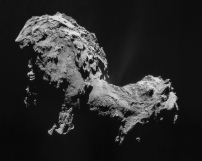
European scientists from the Rosetta mission have found oxygen—"a lot of oxygen"—in the atmosphere of comet 67P/Churyumov-Gerasimenko.

The Los Angeles Times said it was a discovery "that could change our understanding of how the solar system formed."

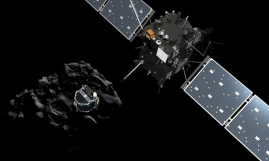
The molecular oxygen (O2) was detected by the ROSINA mass spectrometer, one of the instruments aboard the Rosetta spacecraft that has been traveling with the comet since August 2014.

The finding stunned the scientists. "The first time we saw it, we all went a little bit into denial because molecular oxygen was really not expected to be found on a comet," said Kathrin Altwegg of the University of Bern in Switzerland, the project leader for ROSINA, the Rosetta Orbiter Spectrometer for Ion and Neutral Analysis.

"It does not sound that spectacular, but it is actually the most surprising discovery we have made so far on 67P," she said of the comet, which is about to pass the orbit of Mars.

Molecular oxygen is rarely seen outside our planet. Astronomers have detected molecular oxygen outside the solar system only twice, and never on a comet, the Los Angeles Times said.

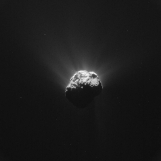
Altwegg said the ROSINA instrument found that oxygen is the fourth most abundant compound in the gaseous coma of the comet after water, carbon monoxide and carbon dioxide. "It is not only that we have oxygen, we have a lot of oxygen," she said.

The researchers could not explain why the comet manages to retain its oxygen despite getting fried when it approaches the sun, where the intense radiation causes it to shed "between one and 10 meters from its circumference."

In a Nature paper describing the discovery, the researchers noted that the ratio of water to oxygen in the comet's atmosphere remained the same over the many months that ROSINA was collecting measurements.

The scientists said this could mean that the oxygen is present throughout the body of the comet and not just at its surface.

And if that is true, the next logical conclusion is that molecular oxygen was present at the time the comet formed, the researchers said.

"The implication that this is primordial material is very interesting. It starts to give you a peek into the environment in which the solar system formed," the Los Angeles Times quoted Christopher Snead, who studies comet dust at UCLA, as saying.

But despite finding oxygen in the comet's coma, instruments have not detected even primordial life on 67P. This leads the scientists to speculate that looking for molecular oxygen outside Earth may not be the best way to look for extraterrestrial life.

"As far as we knew the combination of methane and O2 [oxygen] was a hint that you had life, but on our comet we have both methane and O2, but we don't have life, so it is probably not a very good bio-signature," Altwegg said.


related articles
The Rosetta mission and the meaning of life: What space discovery tells us about our place in the universe

The Rosetta mission to 67P/Churyumov–Gerasimenko is one of the pinnacles of modern scientific achievement. Scientist and theologian David Wilkinson explains its significance to Mark Woods.

\'Hello Earth\': Comet lander Philae wakes up after months of hibernation
'Hello Earth': Comet lander Philae wakes up after months of hibernation

As if waking up from a long, deep slumber, the world's first ever comet lander has once again made contact with its team back on Earth after months of hibernation.

Alien life on comet? Data from 2 probes shows signs of ancient living organisms

Leading astronomers are now focusing their attention on images of organic-rich black crust captured by Philae on the comet 67P/Churyumov-Gerasimenko. These are believed to be indications that signs of ancient living organisms are present beneath the comet's icy surface.

First of its kind: ESA mission to Jupiter moons to search for extraterrestrial life

The undertaking, dubbed the Juice (JUpiter ICy moons Explorer) mission, will begin in 2022 and will explore Jupiter's Galileean moons: Europa, Ganymede and Callisto.

Life from space rocks? Scientists find complex molecules on comet\'s surface
Life from space rocks? Scientists find complex molecules on comet's surface

Complex molecules that could be key building blocks of life were discovered on the surface of Comet 67P/Churyumov­-Gerasimenko, according to a new research published by ESA scientists in a special edition of the journal "Science."

Oddly flickering star 5.8 trillion miles from Earth fuels speculation of alien civilisation

Astronomers and alien enthusiasts are recently turning their attention to KIC 846285, a star located 1,481 light years or 5.8 trillion miles away from Earth. The star, initially discovered by a citizen science program at the Yale University using data from the Kepler Science Telescope, is tickling the curiosity of space enthusiasts primarily due to the odd way it is flickering.

News
Faith in difficult times: lessons from 1930s Britain

Architectural historian Steven Brindle talks to Christian Today about the faith that shaped 1930s Britain, the churches that supported struggling communities and what lessons the decade might have for us today.

Campaign aims to mobilise 500,000 Christians for Christmas outreach

Shine Your Light is aiming to mobilise half a million Christians to share the gospel with five million people across the UK this Christmas, with more than 2,000 churches already signed up, organisers say.

The Church of England should repent for previous calls to ban 'conversion therapy'

The Church of England's uneasiness about the government's ‘conversion practices’ bill is a perfect lesson in the old adage, 'be careful what you wish for,' writes Dr Martin Davie.

Leaked Home Office report links 'Christian extremism' to traditionalist beliefs and immigration concerns

An internal Home Office report lists concerns about immigration, multiculturalism and changing social values among the characteristics associated with what it calls "Christian extremism", it has been reported.