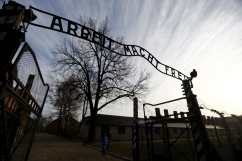
Actor Géza Röhrig, star of a drama set in Auschwitz, has said he believes that God suffered alongside those in the gas chambers during World War II.
Brought up by Jewish friends of his family following his father's death, Hungarian Röhrig told the Guardian that he cannot believe God didn't care about those who died under Nazi rule. "I would not be able to get up from my bed in the morning, let alone pray, if I didn't fully believe that God somehow was there holding the hands of each and every Jew in the gas chamber – each and every Tutsi, Armenian, Kurd, Israeli, Palestinian who suffers unjustly," he said.
"It wasn't God who rounded up the Jews and the Gypsies and the Soviet PoWs and the gays and the perfectly German mental patients and the perfectly German midgets and slaughtered them. We did it. The human family did it," Röhrig added. However, the Son of Saul actor also said: "I do not for one nanosecond like to pretend that God is off the hook. He could and should have stopped it at a much earlier stage."
Röhrig plays Saul in the film, a member of the Sonderkommandos; work units made up of concentration camp prisoners forced to help heard new arrivals into the gas chambers and to dispose of the bodies afterwards. During this process, he discovers the body of his young son, and tries to find a Rabbi to perform a burial ceremony. Described as a front-runner at the Cannes film festival this week, the Guardian's Peter Bradsgaw branded Son of Saul a "horror movie of extraordinary focus and courage".
Röhrig told the newspaper that he "can't imagine a more pressing question" than the existence of God, and that he struggles with the concept of agnosticism, and those who subscribe to it. "We are not living in the same reality," he explained. "Life is so threateningly fragile. I just can't take their attitude seriously. They bore me."
However, his eldest son is an atheist, and Röhrig says the free will to decide for oneself is vital. "I always like to have the option to say no. It's like love," he said.
But for him, faith is essential. "I think there is room for me to believe, as irrational as it sounds, that since God is all-capable, in some mysterious way, he suffered along and was there [in the gas chambers] he added.
"If I wasn't able to believe this, I don't know why I'd take my next breath."