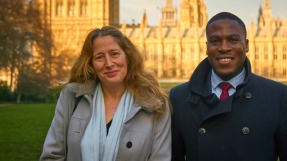
A single mother who changed her mind about an abortion after being helped by pro-life volunteers is taking her legal challenge against censorship zones to the European Court of Human Rights (ECHR).
Alina Dulgheriu is challenging controversial 'buffer zones' that ban prayer and counselling for pregnant women in the immediate vicinity of abortion clinics.
She has mounted a legal challenge in response to the introduction of a Public Spaces Protection Order (PSPO) by Ealing Council that criminalises offers of help near abortion clinics for women facing a crisis pregnancy.
Dulgheriu argues that women facing a crisis pregnancy should be able to receive offers of help.
She says she felt "alone" and "abandoned" when she was left by her partner after becoming pregnant, and thought that an abortion was her only choice. Moments before her appointment, she was approached by pro-life volunteers outside the clinic and offered financial, emotional and material support to help her continue her pregnancy. She cancelled her abortion and kept her baby.
Dulgheriu is taking her legal challenge against the Ealing PSPO to the ECHR after it was upheld by both the High Court and Court of Appeal in the UK, while the country's Supreme Court refused to hear the case.
"What kind of society withholds help from vulnerable women? I'm challenging Ealing Council's PSPO at the ECHR because my experience is typical for many hundreds of others," she said.
"I didn't want an abortion but I was abandoned by my partner, my friends and society. My financial situation at the time would have made raising a child very challenging.
"Thanks to the help I was offered by a group outside of a clinic before my appointment, my daughter is here today. Refusing this charity from offering much-needed services and resources for women in my situation is wrong. Let them help."
Dulgheriu is being supported by the Be Here for Me campaign group. Spokesperson Clare Mulvaney said that the offer of help to a woman facing a crisis pregnancy could be "transformative".
"This is not about being 'pro-life' or 'pro-choice' - this is about offering emotional, financial and material support to women in need," she said.
"And that support has been taken away without good reason. We will continue to support Alina and amplify her voice until justice is served."
Elizabeth Howard, a supporter of Dulgheriu's legal challenge, said over 500 women had accepted help from vigils outside abortion clinics in Ealing in the five years prior to the PSPO.
"Alina's resolve in speaking out for other vulnerable women who only need some help – like she did – is inspirational," she said.
"We support her taking her case all the way to the ECHR. Ealing Council's censorship zone is an affront to human rights and a setback for women's empowerment.
"It's right that the European Court of Human Rights has an opportunity to rectify this injustice."