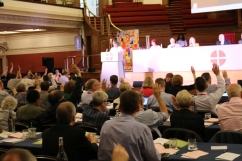
For entirely coincidental reasons, the UK Church scene during the last few days has been dominated by the issue of same-sex marriage. The Methodist and United Reformed Churches (URC) have both taken significant decisions and the Church of England has gone into purdah at its York synod meeting while it tries to sort itself out.
Before all this, last month the General Synod of the Scottish Episcopal Church voted to remove the definition of marriage as between a man and a woman from the revelant canon. In May, the Church of Scotland decided to recognise ministers in same-sex marriages as well as civil partnerships (though they cannot register same-sex civil partnerships or solemnise same-sex marriages themselves; that will be discussed next year).
And in March the Baptist Union of Great Britain said that while it affirmed marriage as between one man and one woman, the decision was up to each church (though it "humbly urged" them not to marry same-sex couples). Ministers still can't enter into same-sex marriages themselves.
It's easy to conclude that the tide is running in a certain direction, and this may be true. However, the Church of England's powerful evangelical and Anglo-Catholic wings between them may well derail moves in favour of same-sex marriage altogether, and the Roman Catholic and Orthodox Churches remain resolutely opposed. Furthermore, the UK's vibrant independent and Pentecostal churches show no signs of budging on the issue, seeing it as a question of faithfulness to scripture. Despite the support of some senior evangelicals for an accepting position, evidenced in Jayne Ozanne's book Journeys in Grace and Truth, in many quarters the dividing lines are as sharp as ever.
However, this still isn't the full story. Because while each denomination has to wrestle with this, each has to do so on its own terms – and for some it's intrinsically easier than others.
The key difference is between denominations with a congregational-style form of church governance and those with an episcopal or presbyterial system.
If the denomination is made up of congregations that are regarded as competent to take decisions on how to interpret the scriptures themselves – like the Baptists or Congregationalists – it is, in theory at least, possible to agree to disagree.
If it's governed from the top down, so that one body – the Church of England's General Synod, the Methodist Conference – decides policy for the whole Church, that's much harder.
Hence the position of the council of the BUGB, a generally conservative denomination, and of the URC. The BUGB council said that while it would very much prefer it if churches didn't register for same-sex marriages, it couldn't stop them. So far, it seems that Baptist churches can live with that. The URC is far less conservative, generally speaking, and does have a presbyteral system of government, but it also allows wide latitude to its congregations. So it was possible to devolve the decision to local churches in a way that would not be possible for Methodists, who have a "Connexional" system of governance whereby Conference decisions are binding on all, or the CofE.
This doesn't mean Baptists don't have a hard road to tread. So far there has been no concerted effort to allow for the recognition of ministers who are themselves in same-sex marriages, and any such effort would be defeated. In principle, though, it might be argued that the congregational principle might be extended to cover them as well.
The problem for Churches that have a centralised system of government is that their decision-makers don't just have to be able to carry a large majority of their ministers and members with them. They also have to be able to persuade the minority to stick with their Church even if they don't get what they want. They can do this by persuading them of the value of unity, offering some hope of change in the future, or putting arrangements in place that give them enough to keep them loyal by assuring them that they're valued and respected.
In the case of women bishops and the CofE, this seems to have worked. Same-sex marriage is on another level of difficulty altogether, however, and it's impossible to say what will happen.
This doesn't, of course, mean that one system of Church governance is necessarily better than another. But it might be argued that the congregational system is better adapted to the confused and fragmented state of modern society and theology.
On the other hand, it might be argued that it offers just the opportunity to compromise with the spirit of the age that the Church doesn't need.
Either way, there's nothing simple about the way ahead.
Follow Mark Woods on Twitter: @RevMarkWoods