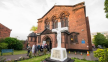
The Wayside Pulpits beloved of some Christians ("CH--CH – what's missing? UR!") have their counterparts in other faiths too. Birmingham's Central Mosque, for instance (pictured), has a sign saying "Read Al-Qur'an, The Last Testament" prominently displayed.
When I read it for the first time, it grated: as far as I'm concerned, the New Testament is the last testament, thank you very much. Then I thought about our own Christian terminology of New and Old Testaments, and what that said to Jews, and repented.
What I went through at a rather vague and superficial level is, I think, what a programme called Scriptural Reasoning wants to encourage in a much deeper and more challenging way.
Beginning in the 1990s in North America, it brings together in small groups participants mainly from Jewish, Christian and Muslim traditions – though other religions have been included too. They look together at texts from each other's scriptures, trying to make sense of what they mean and their implications today. Groups can use suggested 'Text bundles' bringing together passages from different scriptures on similar themes such as "The extra mile", 'Using God's gifts" and "Women and equality" – and, at the meeting I attended in Bristol University's multi-faith chaplaincy centre, "Riots and rebellion".
As it happened, there were no Muslims present, so we confined ourselves to the Jewish text – Numbers 16: 1-6, Korah's rebellion – and the Christian, Acts 19: 23-29, the riot in Ephesus instigated by Demetrius the silversmith. Each had a few sentences of explanation underneath, and was briefly introduced by someone from the relevant faith: the "host", as we were advised to think of them, with the rest of us as guests.
We were a small group of eight, a mixed bunch, and not – I was glad to see – particularly high-powered, theologically speaking. There were two Jews from a Liberal congregation, two Nonconformists, an Anglican and three Catholics.
Several of the group were long-standing members, which fosters trust and understanding; others were newer. The group's leader introduced the session by saying, "We do not have to agree, but the idea is to promote a better quality of disagreement." We were not, she said, looking to "flatten out" our experience of the text. So, "Be respectful of others' texts, but don't be afraid to dive in".
It was a fascinating experience, not least for the humility imposed on Christians reading the Old Testament by the presence of those who had it before us. It was and is "theirs" before it was "ours". Small things made the familiar strange: for instance, a Jewish participant read it aloud, and pronounced the names differently (correctly, presumably).
We talked about the story very much as we might have done at a church home group or Bible study: this is how I respond to it, this is what it seems to say. There was a good deal of agreement: we all rather liked the rebels' complaint that Moses and Aaron were getting above themselves ("All the congregation are holy, all of them, and the LORD is in their midst"). Their sturdy democracy spoke to my Baptist soul, though the Christians from heirarchical Churches were adamant that their traditions opposed authoritarianism too. The Jewish participants brought us back to a closer reading: this was a pretext for the rebellion, which had far less worthy causes.
So we talked about how religion could be misused for evil. There are melancholy modern examples. The earthquake which swallowed up the guilty parties was also provocative: Christians could dismiss such divine retribution as "Old Testament" thinking, whereas "We Jews are faced with this sort of thing all the time."
The story of Demetrius the silversmith was on the same theme: the makers of images were losing trade because of the success of Paul's preaching, and they whipped up the city to riot in honour of the goddess ("Great is Artemis of the Ephesians!") Again, motives were decidedly mixed. But the story led us to talk about the sacred objects in our own traditions – the scrolls, the ark, the Bible – and how we use them and what we feel about them. It's difficult to imagine a conversation flowing so easily and naturally in another context.
We also talked about our scriptures themselves. Were they history, just because they presented themselves as such? Not necessarily, thought some from both traditions, but that didn't really matter. A Jewish participant spoke of being inexpressibly moved at prayers after a visit to Auschwitz, thinking: "After all that, we're still doing it, we're still being Jewish" – whether the stories are literally true or not.
Some might worry that reading scripture in this context does indeed "flatten" it. This wasn't my experience. It isn't the same as a home group – there were no prayers, for instance – but I didn't feel threatened or compromised for a moment. One of the principles of Scriptural Reasoning is that it's not about watering down your own faith. The guidelines say: "A Scriptural Reasoning group can, of course, remain a context in which you show your love for your scriptures and for the way of life they lead you towards. At no time are you ever called to compromise your faith commitment."
Neither, it should be said, is it about converting people, though it's recognised that in some traditions this is important. In the context of the group, we're told: "Everyone in the group needs to behave, however, in such a way that all participants will feel safe from any pressure to accept another tradition, or any attack on their own tradition."
Reading and talking about scripture – your own and other peoples' – with people who don't share your faith is both fascinating and humbling. It's also a model of inter-faith engagement generally – meeting on flat ground, with no other agenda than to learn and understand.
More broadly still, it might say something about an approach to evangelism. All of those present at a Scriptural Reasoning evening are believers. Most people in the UK aren't, in the sense of belonging to an active faith community. What does the model of sitting in a circle, patiently and respectfully trying to understand a text which is strange to us but means something profound to someone else, have to say in a context like that?