Pope Francis to visit Armenian genocide memorial amid feud with Turkey

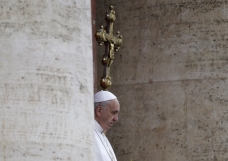
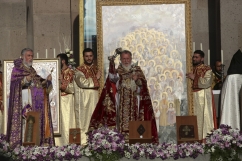
Pope Francis told Armenians that he is travelling to their country this weekend as a "pilgrim" to learn from the country's wisdom and "strengthen our communion" with their Orthodox Church.

In more than 1,700 years as an officially Christian country "you have found in the cross of Christ and in your genius the strength always to rise again even from the sufferings that were among the most terrible that history recalls," said Francis in a video message broadcast on Armenian television yesterday.

He said he both admired the Armenian people and shared in their suffering.

More than 1.5 million Armenians were massacred by Ottoman Turks during World War One.

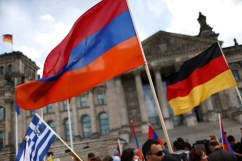
Though nearly a dozen EU countries formally recognise the genocide, Turkey has consistently disputed it. It accepts that many Armenians died in partisan fighting, but denies that the figure is as high as 1.5 million, and says that it did not amount to genocide. 

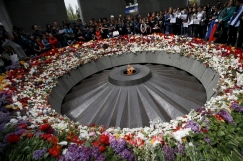
The Pope will travel on Friday for three days and visit the Tsitsernakaberd Memorial Complex in the Armenian capital of Yerevan on Saturday.

"We must not allow painful memories to take possession of our hearts. Even in the face of repeated assaults of evil, we cannot give up," he said.

In April last year, Francis called the Armenian massacre the "first genocide of the 20th Century". Turkey responded at the time by immediately recalling its ambassador to the Vatican to Ankara for consultations. He did not return for 10 months. The Turkish President warned the Pope to "not repeat this mistake".

During the television broadcast on Wednesday Pope Francis referenced the story of Noah's Ark,  which is traditionally important to Armenians.

He told Armenians to be like Noah "who after the flood never tired of looking toward the heavens and kept releasing doves."

When a dove returned with an olive branch, Noah knew "that life could begin again and hope could be revived."

The Pope said he will visit "as a pilgrim in this jubilee year to draw from the ancient wisdom of your people and drink from the springs of your faith."

related articles
Pope Francis pays tribute to victims of Armenian genocide

Pope Francis pays tribute to victims of Armenian genocide

Pope calls Armenian massacre \'first genocide of the 20th century\'
Pope calls Armenian massacre 'first genocide of the 20th century'

Pope calls Armenian massacre 'first genocide of the 20th century'

Armenian Church canonises 1.5 million genocide victims

Armenian Church canonises 1.5 million genocide victims

Turkey needs to admit the Armenian Genocide before it joins the EU

Turkey needs to admit the Armenian Genocide before it joins the EU

Turkey to get first new Syriac Orthodox Christian church in nearly a century

Turkey to get first new Syriac Orthodox Christian church in nearly a century

Germany recognises massacre of Armenians as \'genocide\'
Germany recognises massacre of Armenians as 'genocide'

Germany recognises massacre of Armenians as 'genocide'

News
Pope seeks prayers for peace in Christmas Day message

The Pope asked people to pray in particular for the "tormented people of Ukraine" in his Christmas Day 'Urbi et Orbi' message. 

Who was St Stephen and why is he remembered on December 26?

The carol says, “Good King Wenceslas last looked out on the Feast of Stephen.” In many countries, December 26, also known as Boxing Day, is better known as St Stephen’s Day. Stephen was the first Christian martyr. This is the story …

King Charles reflects on pilgrimage, reconciliation and hope in Christmas Day address

King Charles III used his Christmas Day speech to reflect on the significance of pilgrimage as he appealed to the nation "to cherish the values of compassion and reconciliation". 

2 Timothy 3:16 is Logos' Bible verse of the year, Matthew was the most studied book

One of the most-studied Bible verses of the year is from 2 Timothy in the New Testament, according to an analysis of millions of Bible study sessions that tracked how believers worldwide are engaging with Scripture.