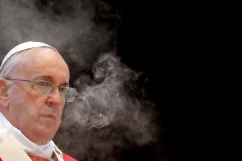
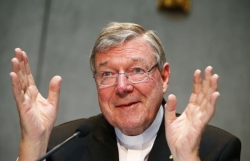
Pope Francis has approved a major reorganisation of Vatican finances, appointing several controllers and putting his director of the reforms, the Australian Cardinal George Pell, in the number one slot at the Secretariat of the Economy.
The reforms represent a Papal seal of approval for Cardinal Pell, up to a point.
According to the influential Italian newspaper Il Messagero, Cardinal Pell, who has been accused in the Italian current affairs magazine L'Espresso of trying to centralise control of Vatican investments and running a large expenses bill, has not gained as much as was originally expected and has even lost some power.
L'Espresso claimed Cardinal Pell spent more than $500,000 in six months on his new department, flying business class and paying assistants large salaries, plus $2,800 on robes at a Rome tailor and more than $50,000 on furniture.
The reforms came in three documents approved by the Pope that reshape the finances of the Holy See. They were implemented on 1 March.
The Secretariat of the Economy, headed by Cardinal Pell, will oversee administrative and financial departments of the Roman Curia and linked institutions, as well as Vatican City. But it will not control both investment and spending, as was repeatedly proposed.
La Stampa reported that Cardinal Pell will merely monitor the Holy See's finances and will not actually "handle the goods". There will also be an auditor general and two other reviewers.
The Vatican's finances will be monitored by the Council for the Economy, made up of eight prelates and seven lay people, which will draw up policy to be implemented by the Secretariat.
The Vatican's spokesman, Father Federico Lombardi, earlier defended Cardinal Pell, and said the leaks about his expenses were "complete fiction". Father Lombardi also said the Secretariat was run with a tight budget.
Among the powers lost to Pell was control of the Vatican's real estate, which the Secretariat had assumed last year.
Andrea Tornielli of La Stampa's Vatican Insider column said: "These statutes reveal a collegial result with no winners and losers. There will be no super-ministry with powers of both management and supervision, but Pell does receive a lot of power."
Vatican finances have laboured for years under allegations of corruption. Cardinal Pell was brought in by the Pope to sort them out and implemented strong measures to bring in transparency and accountability. He made enemies when some people felt he had gone too far.
Monsignor Anthony Figueiredo, a director of the Pontifical North American College, told CBS News: "The smear campaign was to be expected. When we touch people's lives, their zone of comfort, there will be a reaction. At the cost of his own personal career and reputation, Cardinal Pell wishes to implement the task given to him by the Holy Father, which is to root out corruption once and for all. For that there will always be a price."