Voting in Nigeria's tensest election since the end of military rule in 1999 spilled into a second day on Sunday after technical glitches hit voter ID machines and Islamist Boko Haram militants killed more than a dozen people in drive-by shootings.
The race pits President Goodluck Jonathan against former military ruler Muhammadu Buhari for the favour of an electorate divided along a complex mix of ethnic, regional and in some cases religious lines.
The poll is seen as the first election in Africa's most populous nation in which an opposition candidate has a serious chance of unseating the incumbent, and widespread fears it could trigger violence are already becoming reality.
Islamist insurgents launched several attacks on voters in the northeast on election day, killing three in Yobe state and 11 in neighbouring Gombe, including an opposition parliamentary candidate.
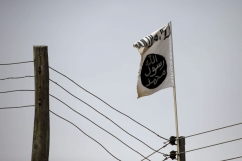
The militants, who are trying to establish an Islamic caliphate in religiously mixed Nigeria, reject democracy and their leader Abubakar Shekau has threatened to kill those who go to vote.
A string of military victories by troops from Nigeria and neighbouring Chad, Cameroon and Niger has reclaimed much of the territory the Islamists controlled earlier this year, but they retain the ability to mount deadly attacks on civilians.
Voting at the 120,000 stations nationwide was beset with problems from the start as officials turned up late and biometric card readers, introduced to prevent the vote-rigging that has marred previous polls, failed to work.
Even President Jonathan suffered a 40-minute delay as officials vainly tried to get four different machines to recognise his fingerprint.
"I'm very hopeful," he said of his chances after voting.
With up to 56.7 million voters to process, the election commission extended voting into Sunday in districts that had suffered technical problems. It was not clear what impact this would have on the timing of the result.
A credible and relatively calm poll would open a new chapter in the chequered history of Africa's biggest economy and top oil producer, whose five decades of independence have been tarnished by military coups and secessionist unrest.
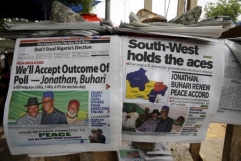
Buhari and Jonathan have appealed for calm and signed a 'peace accord' on the eve of the vote, but many Nigerians still fear a repeat of the post-election violence that erupted in 2011, when 800 people died in the mainly Muslim north after a Buhari defeat, also to Jonathan.
"The danger is post-election," former Malawian President Bakili Muluzi, who is leading a Commonwealth observer mission, told Reuters. "We've been assured by the peace accord between the leaders but how that trickles down is the danger."