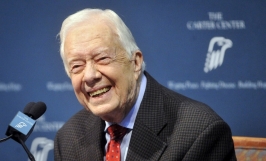
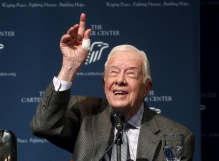
If there's one thing that former president Jimmy Carter's successful treatment for cancer proved, it is that scientists have made a marked improvement in treating this deadly disease.
Experts told USA TODAY that the drug used in his treatment called pembrolizumab, also known as Keytruda, is part of a new class of drugs that fight cancer by boosting the body's immune system. Timothy Turnham, executive director of the Melanoma Research Foundation, revealed that it is one of the eight new melanoma drugs approved since 2011.
Even though none of the new drugs had been proven to cure cancer, patients and cancer advocates have celebrated their arrival. It is noteworthy that the FDA did not approve these drugs at all from 1998 to 2011.
Len Lichtenfeld, deputy chief medical officer of the American Cancer Society, said the drug causes the cancer to shrink or stop growing. Around one-third of patients who take Keytruda showed significant improvement.
Because both Turnham and Lichtenfeld are not involved with Carter's case, they said they could say for sure that his recovery was due to Keytruda since it could also be the result of remission.
"People who respond to drugs like Keytruda tend to respond for a while," Turnham explained. "There is every likelihood that when he dies, it will be from something other than melanoma."
He said cases such as Carter's is especially difficult to treat because the cancer has spread to the brain. Only a few drugs can get past the "blood-brain barrier," which is a system that protects the brain from bacteria and infections.
However, Keytruda is effective because it can shrink the brain tumours indirectly "by revving up immune cells that can cross into the brain."
There are still some concerns with the new drugs though, particularly with the price, he said, adding that new cancer therapies are now introduced at around $100,000 a year.
"These breakthroughs that happen quickly don't come out of a vacuum," Turnham said. "It's like building a skyscraper. You wait for months and there is nothing but a hole in the ground. Then, you turn around and it's 10 stories high. Basic science is like that foundation (of a skyscraper). Once you understand what is going on in the cancer at a biochemical level or a molecular level, you can accelerate and have tremendous progress."