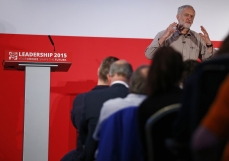
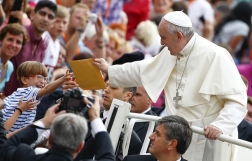
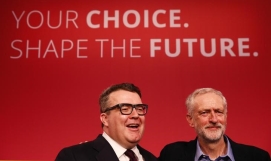
Strong similarities are emerging between Jeremy Corbyn and the Pope, on the brief but vivid evidence available so far. However much Corbyn might deplore the suggested parallels, both preach a radical social gospel, even though one does not do God and the other most definitely does.
Corbyn is an avowed republican. The hierarchy he has rejected all his life is that between deity and monarchy, the untouchable superiority of administration. Right from the first line of the National Anthem, Corbyn would be seen to be publicly renouncing everything he has held dear in life if he were to join in. It starts with a word whose validity he questions, God, then it calls upon this, for him, questionable entity to protect the figurehead of a constitution which repels him for its shoring up of patronage. "Send her victorious" then runs straight into the imagery of war. It is the absence of all these three, this striking royalist trinity of God, monarchy and war, that has defined his political ideology.
Having done that, he would be asking for the long-term subjection of the citizen to the Crown. Never mind that he might have found human rather than divine relevance in the full version: "Confound their politics, Frustrate their knavish tricks."
Corbyn comes from a completely different place than the jingoistic support for Crown some of these less-frequently sung verses imply. He will not be a hypocrite. He does not want to mouth what he does not believe. But he clearly does have a faith of sorts.
Although he has been coy in answering whether or not he is a Marxist, Corbyn has said that many of Marx's writings are worthy of study. And on the evidence of his utterances both now and the decades he has been in Parliament, it would be the political understatement of this still-young century to say that Jeremy Corbyn is more Marxist than monarchist.
Marxism started as a social and economic critique largely based on the specific study of working classes in the hothouse of industrial advance in the 19th century. Marx and Engels analysed the conditions in Manchester, northern powerhouse of industrial advance. There are those who would class Marxism as if not a religion, certainly a faith, with its very clear articles of belief, or doctrine.
It directly addresses the condition of mankind and our relations with our fellows. It has its texts, its witnesses, its martyrology and its own kind of millennial fervour. It doesn't do God, at all, and if it has a heaven, that place is to be sited right here on earth. Nevertheless, a lot of Marxists have been Christians and still are, especially those from Latin America.
Corbyn's election was welcomed by Argentina as a sign of the winds of change happening over the Falklands. Similarly, the election of Pope Francis, former Archbishop of Buenos Aires, has fanned the flames of hope for the Argentinians who want their Malvinas back, although the Pope has been cautiously diplomatic on this issue. This is just one area where they might find common ground.
Both Corbyn and the Pope are bringing trouble in their wake in their uncompromising refusal to succumb to the lures of hypocrisy. It is almost like Luther: "Here I stand, I can do no other." Defence spending is just one but perhaps the most important issue Corbyn needs to get his act together on. The first duty of government is to protect its citizens.
And just as Corbyn is massively popular with his membership, in the US and the Western world, there has rarely, if ever, been such a popular Pope with the people.
Corbyn will almost certainly get on well with the Pope given their shared social thinking. As with Corbyn, there is concern about some of Pope Francis' views. The Pope is ruffling feathers of the powerful on issues such as the environment, poverty and migration. The Pope is not a friend of capitalism. He believes money is "the devil's dung".
But, true to Scripture, he is prepared to render unto Caesar as well as unto God. This is not hypocrisy, it is biblical.
This accommodation between the Bible fundamentals and the world makes it possible for the Pope to do serious business with President Barack Obama, the political and metropolitan elite in Washington and New York, with the UN and with his own Catholic hierarchy and faithful in the US later this month. It means he can deal equally well with Fidel Castro in Cuba who he will also meet on his preceding visit there.
Corbyn, on the other hand, lacking faith in God, is apparently not prepared to compromise his own secular faith and render unto his version of "Caesar", the monarchy, in order to sing the National Anthem. Perhaps he has never heard, understood or cared about the arguments presented by Jesus in the Gospel. It would be a tall order to convert Corbyn. But possibly that is one of the few things now that could save him and the Labour Party, literally and spiritually. Maybe the Pope is the only man for the job.