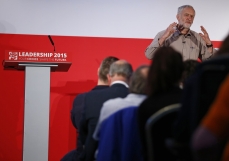
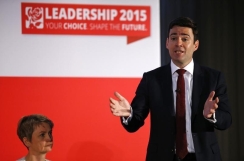
Jeremy Corbyn has been elected as Labour's new leader in a result that is set to reshape Britain's political landscape.
His victory with more than 251,000 votes – 59.5 per cent of those cast – is a stunning defeat for the other candidates. His closest rival was Andy Burnham – seen as the front-runner when the contest started – with 80,462 votes or 19 per cent.
Corbyn paid tribute to interim leader Harriet Harman and also to former leader Ed Miliband, saying that he had thanked Miliband for the way he had stood up to the "abuse" he had received from the media, particularly over criticism of his father Ralph.
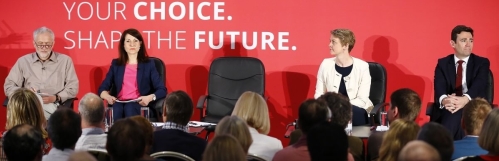
He praised his fellow-candidates and noted that they had concluded their campaigns with a "group hug", joking that they would "form themselves into an Abba tribute band". He noted Burnham's commitment to the NHS and Yvette Cooper's recent statements on refugees. He expressed his admiration for Liz Kendall, saying that she was fearless in standing up for her beliefs.
Corbyn also attacked media for what he said were attacks on his family during the campaign, urging them to "leave people alone" and concentrate on the political issues.
Referring to the young people who had joined the party during the campaign he said that though they had previously been written off as non-political, they had actually been "turn off" by the way politics had previously been conducted. He committed himself to support Sadiq Khan, Labour's candidate for London.
Corbyn said that the Labour Party needed to develop an economic policy that addressed society inequalities. In a rally-cry to supporters, he said that the party would "shape the future of everyone in this country in a way that will be remembered as good for everyone". He concluded: "Poverty isn't inevitable. Things can and they will change."
Seen as an outsider when he first made it on to the ballot paper – helped by Labour MPs who said that they did not intend to vote for him but believed it was important his voice was heard – a remarkable wave of support for the left-wing candidate has seen him surge to victory.
Now he faces the task not just of leading the opposition to the Government but of unifying his own party around him, many of whom are aghast at what they see as his extreme polices and fear that he will make Labour unelectable in 2020. Several senior figures have already said that they will not serve in a Corbyn shadow cabinet and shadow health secretary Jamie Reed, a Corbyn critic, announced his resignation immediately.
However, Corbyn himself has promised a new style of politics, saying ahead of the result: "Fundamentally many people are turned off by a political process when the major parties are not saying anything different enough about how we run the economy, and totally turned off by a style of politics which seems to rely on the levels of clubhouse theatrical abuse that you can throw across at each other in parliament and across the airwaves."
He told reporters at his final campaign rally that a Labour government would offer a clear alternative to Conservative austerity. ""There has to be public investment in order to bring about a growing economy. You can't cut your way to prosperity, you grow your way to prosperity."
The prospect of his election was regarded with dismay by senior figures. "The party is walking eyes shut, arms outstretched over the cliff's edge to the jagged rocks below," warned former prime minister Tony Blair in one of three increasingly desperate pleas to voters to stop the Corbyn surge.
But by promising to increase, rather than cut, government investment though money-printing, Corbyn has found favour among disillusioned young voters and socialists who had drifted away from the party after nearly two decades battling for the political centre ground.
Labour's probable abandonment of the political centre ground, particularly on the subject of balancing Britain's books, is seen by many as a gift for the Conservative Party that could herald a prolonged spell in power for the centre-right party.
Tom Watson has been elected deputy leader on a turnout of 408,470 votes cast. He achieved 39.4 per cent on the first round but won with second preferences from lowest-placed candidate Ben Bradshaw. He said that "only Labour can speak for the real Britain. We haven't always, but that's what we have to do again."
In an attempt to reassure those who feared division, he said: "There is only one Labour." He added that "anyone who thinks there is a contradiction between [being] pro-business and pro-worker doesn't understand either".