Lord Carey, the former Archbishop of Canterbury, has made an impassioned plea to the government to help persecuted Christians in the Middle East and beyond. Writing in The Telegraph, he speaks frankly about his disappointment in the role the government has played.
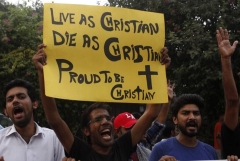
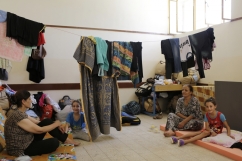
He talks about the large numbers of Christians being killed, forced out of their homes and otherwise persecuted simply on account of their faith, especially in Syria and Iraq. 'The British response to this disaster, which we have in part caused by our ill-judged interventions, has been woeful,' he said.
Highlighting that fewer than two per cent of Syrians given asylum are Christians, despite around 10 per cent of Syrians being Christian, Lord Carey lambasts the government. 'The stark truth is this that there is an institutional bias against Christians by our government,' he argues. 'All this is in sharp contradiction to the promises of support for persecuted Christians made until recently by successive Prime Ministers including David Cameron and Theresa May. Are they just hollow words?'
Carey also claims to have advice that the lack of support for Christians amounts to illegal as well immoral action. 'It is not just a manifesto promise that has been broken,' he says. 'The law has been broken. So says advice I have received from the religious liberties barrister Paul Diamond.'
In retirement, Carey has become an advocate for numerous causes. Some of his pronouncements have not been well judged and at times he has courted controversy.
Yet here, he seems to be highlighting an important point. Those of us without expertise can't judge the legality of the situation, but it does seem that, at a time of existential challenge to Christian communities in the Middle East, the British Government's response has been somewhat lukewarm.
First, consider the meagre amount of refugees the government has agreed to take. Just 20,000 over five years. This means we're being inhospitable to Christians (as well as Muslims and other minorities). The government's response to this accusation is that the UK is one of the top donors to help refugees in the Middle East itself. This is important to note – and should be a source of pride. But in itself it doesn't mean that we shouldn't be accepting more refugees. The sheer disparity between the millions who've been accepted in Jordan, Lebanon, Germany and elsewhere means we must pull our weight.
Second, the accusation made by Lord Carey does need to be carefully looked at. Although as Christians we shouldn't want to prioritise Christian refugees at the expense of Muslims or others, we also should be aware of any bias against Christians. Lord Carey's accusation that because refugee camps are run by Muslim officials they are less likely to welcome Christians is a serious one. If it means that the UK is giving less help to Christians as a result, that's a big issue.
Third, persecution against Christians is endemic in places. We mustn't be afraid to say it is so. The suffering our sisters and brothers are undergoing is almost incomprehensible. There is, of course, significant wrong being done elsewhere, such as the horrendous persecution of the Rohingya Muslims in Burma. Yet it is surely incumbent on the British government to highlight and act practically to support Christians wherever possible – especially in Iraq, where the current chaos which has allowed such persecution was ushered in by the calamitous British and American invasion in 2003.
A Government spokesman said: 'UK aid is provided in line with humanitarian principles, so whoever needs our help the most gets it first, regardless of race, gender or religion. We work with trusted partners who operate in line with those same principles of neutrality and impartiality, including in practicalities such as refugee camp management and staffing. To suggest otherwise is wrong. And with all of our resettlement schemes we work closely with UNHCR to identify cases that they deem most in need of resettlement according to their established vulnerability criteria.'
The UK is a medium-sized world power and can't be expected to solve all the world's problems. But a genuinely ethical foreign policy – one based on Christian values – would see us prioritising the most vulnerable. In parts of Syria and Iraq at the moment, the most vulnerable are the Christians who have been mercilessly targeted because of their faith. We should be doing absolutely everything we can to help them.