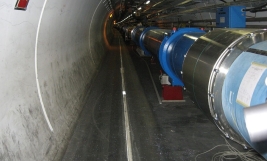
The world's largest and most powerful collider has reached a new breakthrough, and this can help scientists understand more how life began on Earth.
The Large Hadron Collider (LHC) recently managed to recreate the first nano-seconds of existence, or the moments after the Big Bang. This was achieved by using lead-ion collisions at a record energy of 1045 trillion election-volts.
This tremendous amount of energy is actually two times higher than that produced in any previous experiment.
The feat was achieved on Nov. 25 by physicists at the European Organisation for Nuclear Research (CERN) after turning the supercollider offline from 2013 to 2015 in an effort to observe a lengthy maintenance period for the powerful device.
The LHC only went online last April and has been since working its way back up to full capacity.
CERN Director General Rolf Heuer himself touted his organisation's latest achievement.
"It is a tradition to collide ions over one month every year as part of our diverse research programme at the LHC. This year, however, is special as we reach a new energy and will explore matter at an even earlier stage of our universe," Heuer told The Express.
He further underscored the importance of the LHC's latest breakthrough in understanding how life began to exist on our planet.
"Early in the life of our universe, for a few millionths of a second, matter was a very hot and very dense medium—a kind of primordial 'soup' of particles, mainly composed of fundamental particles known as quarks and gluons," the CERN director explained.
Heuer further said the LHC can increase the volume and temperature of the soupy matter by increasing the energy of lead-ion collisions.
"In today's cold Universe, the gluons "glue" quarks together into the protons and neutrons that form bulk matter, including us, as well as other kinds of particles," he added.