
When the Apostle Paul wrote of the “perversion” of men and women who committed “indecent acts” with those of the same sex, he was talking about people he understood to be heterosexuals engaging in same-sex acts, according to The Episcopal Church’s first actively-gay bishop.
“It never occurred to anyone in ancient times that a certain minority of us would be born being affectionately-oriented to people of the same sex,” Bishop V Gene Robinson stated this week.
“So it did seem like against their nature to be doing so,” he added, referring to the exchange of “natural relations for unnatural ones” by men and women, as Paul recorded in Romans 1:26-27.
Robinson, whose consecration in 2003 has strained relations between The Episcopal Church and the wider Anglican Communion, was responding to a question posed by a reporter for conservative CNSNews.com following a press conference in Washington this week.
Upon engaging Robinson, the reporter had brought out Romans 1:24-27 and asked the New Hampshire bishop if he thought Paul was correct in describing homosexual acts as being against nature.
Robinson, in response, said the question would take about two days to answer, but to explain simply, the bishop told the reporter that the passage – like any other in the Bible – needed to be understood in its own context.
“We have to understand that the notion of a homosexual sexual orientation is a notion that’s only about 125 years old,” he said before asserting that Paul’s admonition was to heterosexuals and not homosexuals.
Robinson also claimed that Paul was speaking out against child abuse, noting that in Paul’s time, older men were known to take younger boys under their wings and use them “sexually, and so on”.
“No one is arguing for that (child abuse) today. We would all be against that,” Robinson stated. “We would all agree with St Paul on that.”
He said the “real question” when looking at Scripture involved what the person meant when they wrote what they did, and what it meant for those to whom they wrote it.
“And only then can we ask, ‘Is it eternally binding?’” the bishop added. “And in this case, I would say, the things that St Paul was against, I’m against too.”
As for the question about whether “faithful monogamous lifelong-intentioned relationships between people of the same sex” is right, Robinson asserted that the Bible “simply does not address that”, though theological conservatives would fiercely argue otherwise.
“The questions we’re asking today are about a completely different set of circumstances,” he concluded.
Robinson, who was married and has two daughters, divorced his wife and is now involved in a homosexual relationship.
He currently serves as the ninth bishop of the Diocese of New Hampshire in The Episcopal Church.




-

Wycliffe celebrates ‘remarkable moment’ as Bible translation advances at rapid pace
-

Could the Church face a ‘silver uprising’?
-

Christian leaders issue ‘sober and urgent call’ for Western Church to prepare for disruption
-

Church in Wales pauses plans to allow gay marriage
-

800 years on: Why St Francis of Assisi still captivates the world
-

500 million Christians worldwide face Bible access restrictions, report finds
Most Popular
News
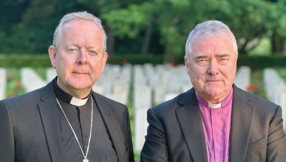
Irish archbishops urge peace and reconciliation amid Drumcree stand-off
Ireland’s Catholic and Church of Ireland archbishops have appealed for an “urgent” initiative to resolve the Drumcree parade dispute and asked Christians to pray for peace.

Former priest Chris Brain convicted of rape as Church review set to begin
Former Church of England priest Chris Brain has been convicted of rape and four counts of indecent assault following a retrial.

Franklin Graham preaches with warning from Sodom in Manchester
Franklin Graham used the biblical story of Lot’s flight from Sodom to urge thousands in Manchester on Saturday night to seek forgiveness through Christ and accept His gift of salvation.

More than 4,200 Christians killed in Nigeria this year - report
More than 4,200 Christians have been killed in Nigeria so far this year, according to a new report calling for stronger action to protect communities facing violence across the country’s Middle Belt.








