The writer of the Letter to the Hebrews reminds Christians that they are surrounded by a great “cloud of witnesses.” (NRSV) That “cloud” has continued to grow in size since then. In this monthly column we will be thinking about some of the people and events, over the past 2000 years, that have helped make up this “cloud.” People and events that have helped build the community of the Christian church as it exists today.
The Name of the Rose is a 1980 historical murder-mystery novel by Italian semiotician and author Umberto Eco, which was also adapted into a 1986 feature film and a 2019 television miniseries.
The backdrop to the novel is a major 14th-century dispute over Franciscan poverty, both within the Franciscan Order and between the Franciscans and Pope John XXII. Eco sets the novel in 1327, precisely when this controversy was reaching a particularly dangerous stage.
The fictional William of Baskerville – who is central to the novel – is a Franciscan sympathetic to the radical idea of renunciation of worldly wealth, and the abbey where a series of murders occur is hosting a crucial (and potentially explosive) theological meeting between representatives of the Franciscan side and the papal side.
The disagreement that is central to this meeting centres on this question: ‘Did Christ and the apostles themselves possess property?’ If they had possessed absolutely nothing, then radical Franciscan poverty could claim to be the authentic model of Christian life. This question – and its answer – had huge social and political ramifications, as well as theological ones.
The fictional detective investigation that occurs in the book is taking place against a very real historical struggle in which theological disagreement could lead to accusations of heresy, excommunication, imprisonment, or worse. And it was all rooted in an increasingly bitter and violent falling-out over the legacy of Francis of Assisi.
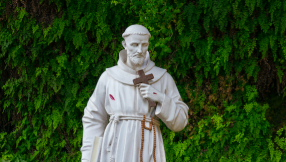
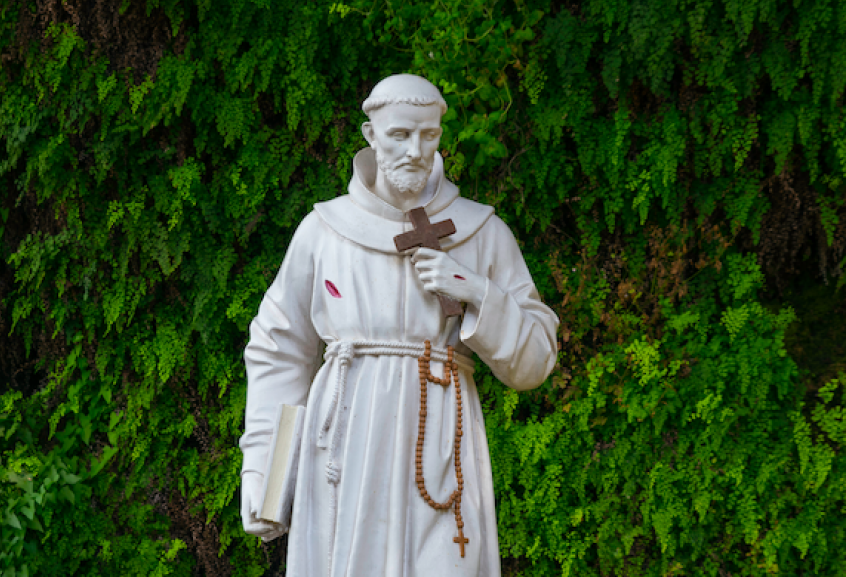
It’s all a long way from modern images of the saint preaching to birds and wild animals. In the 800th year since the death of this famous saint (in October 1226), it is worth reflecting on his legacy in the century after his activities. For those who debated it at the time, the discussion soon became explosive …
The impact of Francis of Assisi
When Francis of Assisi died, on 3 October 1226, he left behind no theological system or blueprint for reforming the Church. Instead, he left an example of Christian discipleship that embraced personal poverty, humility, service to the marginalised, and imitation of Christ that has inspired many since. However, within a century his followers were bitterly divided over what this example required of them and of the Franciscan Order. Did they represent a radical authentic model of Christian life? And, if so, how could they coexist with the powerful and immensely wealthy institution that the Christian Church had become?
They were wrestling with the challenge of how should the Franciscan Order adapt to institutional demands made on it by the Church hierarchy, while remaining faithful to its founder? At the centre of this quest was a matter of authority: who possessed the authority to interpret the meaning of the Francis-phenomenon: the pope, the Order’s leaders, or those within the movement (as well as on its periphery) who were committed to implementing this lifestyle in ways that challenged the power-structures of their contemporary society?
These questions culminated in the 14th-century confrontation between Pope John XXII and leading Franciscans, particularly Michael of Cesena and William of Ockham. The dispute over poverty rapidly became a struggle over ideas about ownership of property, over papal authority and the relationship between the radical demands of the gospel and the institution of the medieval Church.
The debate over the legacy of Francis
Francis had made poverty a way of imitating Christ. It was not simply an ascetic discipline. Though born into a prosperous merchant family in Assisi, he had renounced his inheritance and – in stark contrast – had embraced preaching, service and dependence upon others. His clear concern for outcast lepers and the poor, along with his love of God’s creation, expressed a distinct spirituality which was grounded in humility, service and fellowship. He became known as “il poverello” (little poor man), and it was said that he married “Lady Poverty.”
Francis died in October 1226 and was canonised by Pope Gregory IX as early as 1228. This was a stellar post-mortem career. During the later 1220s Assisi became a centre of pilgrimage, as the Franciscan movement expanded across Europe. Unlike monks, who lived principally within monasteries, the friars were so-called ‘mendicants,’ depending upon alms while preaching, teaching and serving urban communities. They soon became very popular and, as they did so, their popularity prompted some animosity from established - monastic - Orders and parish clergy.
However, expansion brought practical difficulties. The Franciscan Order soon acquired houses to accommodate friars, churches, books and administration. How could it sustain these (apparent) necessities while professing the poverty of Christ and his apostles that had underpinned the life of Francis? It was a tricky question, to put it mildly.
The Rule of Francis, approved by Pope Honorius III in 1223, made poverty central to the Franciscan vocation. Yet his followers soon needed authoritative interpretations of his intentions as to how to take the movement forward. One who made a significant contribution to this was named Bonaventure, who was minister general from 1257 to 1274. He attempted to reconcile Francis’ spiritual example with ongoing institutional requirements. He is often called the ‘second founder’ of the Franciscan Order, as he balanced the radical poverty ideals associated with Francis with the institutional needs of a rapidly growing movement.
He did this by establishing a legal and theological distinction between the use of goods and the ownership of goods. He argued that the Franciscan Order completely renounced all dominium (legal ownership) of property, books, and buildings and, instead, transferred these entirely to the Holy See (the Papacy). The friars merely maintained the usus (use) or usus pauper (restricted, poor use) of these necessities to carry out their ministry. To curb what he viewed as the twin dangers of extreme laxity and fanatical extremism within the Order, Bonaventure drafted the Constitutions of Narbonne. This set uniform rules on what friars could wear, eat, and use; it barred friars from directly handling money; limited the size and decoration of Franciscan churches; and set boundaries on how resources could be managed through the oversight of external papal agents (procurators).
Francis was notoriously sceptical of academic theology, as he feared it bred pride and destroyed the spirit of holy prayer. In contrast, Bonaventure was a master at the University of Paris and argued that, in order to preach effectively against heresies and to guide the Catholic faithful in growing urban centres, friars needed education and so he reframed study as a form of spiritual work.
The result was a strategy of reimagining Francis, in order to heal the deep ideological rifts between the so-called ‘Spirituals’ (who demanded a return to Francis’ literal and rigorous poverty) and the ‘Relaxati’ (who favoured institutional structures). Bonaventure spiritualised the – very literal – poverty of Francis and presented him, instead, as a Christ-like figure, and identified him as “the angel of the sixth seal” (Revelation 7:2-3). This presented Francis as a unique prophetic herald sent at the end of time. Crucially, though, instead of framing Francis as a rebel against the hierarchy of Church and state - as some 13th-century ‘Spiritual’ Franciscans (influenced by the apocalyptic theories of Joachim of Fiore) had done - Bonaventure reimagined him as a herald sent by God to save and support the Catholic Church.
In Revelation, the angel of the sixth seal marks the servants of God with a sign to protect them from the coming cataclysmic judgments. In the view of Bonaventure, those who followed Francis’ example did not need to exactly imitate his embracing of poverty. Instead, they were to imitate his Christ-centred spirit. In this way they would be marked as rescued from judgement.
To many later observers, Bonaventure saved the Franciscan Order from fracturing into obscure, extreme, ascetic sects and being suppressed by a Church hierarchy that was deeply suspicious of the socio-economic radicalism of its theology. In so doing, he established it as one of the most powerful intellectual and missionary forces of the Middle Ages.
To others it was a sell-out to the world. Bonaventure had removed the detonator from the explosive charge that was Francis of Assisi! This brings us back to the controversy that nearly tore the Franciscan Order apart.
A debate turns into a crisis
Pope Nicholas III had issued a decree in 1279 which stated that friars could use necessary goods without owning them, while legal title would be held by the Holy See (the Roman Church) or others. Some ‘Spirituals’ considered this an evasion of Francis’ intentions, believing that the poverty of Christ and the apostles was a model for the whole Church.
The term Fraticelli was a term applied to various dissident Franciscan groups, particularly those separated in some way from the recognised Order. It was not synonymous with all ‘Spirituals’ - some of these sought reforms within the Order, while others became separatists.
Pope John XXII (pope 1316 to 1334) brought these disagreements to a head. In 1317, he issued a bull (a decree) which required recalcitrant Spirituals to obey their superiors. Four friars were burned as heretics at Marseille in 1318, while others suffered imprisonment. Things were turning very nasty indeed.
The controversy became explicitly theological in 1321, when an inquisitorial investigation in southern France examined the assertion that Christ and the apostles had owned nothing. The issue was whether absolute poverty was an admirable religious practice or a doctrine grounded in Christian faith. If the latter it had huge implications. In response, in 1322, the Franciscan general chapter at Perugia declared that Christ and the apostles had possessed no property, either individually or in common. Michael of Cesena, who was the Order’s minister general, supported this position. As a result ‘evangelical poverty’ was becoming central to Franciscan identity.
Pope John challenged this declaration through a series of decrees. In 1322 he abandoned the papacy’s legal ownership of Franciscan possessions, arguing that the distinction between ownership and use was impractical, particularly for consumable goods. This overturned the compromise established by Bonaventure as it made Franciscans owners of their property!
In 1323 he condemned as heretical the assertion that Christ and the apostles had possessed nothing, individually or collectively. John maintained that the Church (led by the pope) alone had the authority to interpret scripture and administer property. The Franciscans, on the other hand, feared that abandoning Christ’s poverty would allow institutional interests to undermine the Church’s spiritual credibility. Battle lines were being drawn that included: scriptural interpretation, papal authority and the extent to which religious institutions could accommodate themselves to the world without compromising their principles.
The confrontation reached a decisive stage in 1328. Summoned to the papal court at Avignon, Michael of Cesena refused to abandon the Franciscan position. He then fled from the anticipated severe papal reaction with a number of associates, including the English Franciscan theologian William of Ockham, who argued that popes could err and that the authority of the Church could not be equated with the judgement of a single office-holder (ie an individual pope).
Those fleeing Avignon sought protection from Louis IV of Bavaria (the Holy Roman Emperor). Louis was engaged in a political struggle with the papacy and this transformed the poverty controversy into a confrontation over imperial and papal power. The Franciscan criticism of Pope John now had political consequences.
Resolution of the crisis
The controversy was finally resolved institutionally rather than through agreement over the matter of ‘evangelical poverty.’ In 1328, after Michael of Cesena and his associates went into exile, Pope John removed him from his position within the Franciscan Order. The Order accepted papal authority under new leadership. Most Franciscans remained within the Church, though some left in protest.
Michael of Cesena died in exile in 1342, while Ockham continued writing against papal abuses until his death, probably in 1347. While their arguments did not overturn Pope John’s rulings, strict poverty survived as a Franciscan ideal at least. The Observant Franciscans pursued a more rigorous observance of the Rule in the 15th century, followed later by the Order of Capuchins.
The Dolcinians: a related but distinct movement
The Fraticelli were not the only ones in conflict with the worldly wealth and power of the medieval Church. The Apostolic Brethren (and later the Dolcinians), belonged to a wider medieval search for a return to (what they considered) apostolic Christianity.
Gerard Segarelli founded the Apostolic Brethren in northern Italy during the later 13th century, emphasising poverty and itinerant preaching. Some disaffected Franciscans joined the movement. He also condemned the wealth and worldly power of the Church. The movement eventually spread throughout Lombardy and into Germany, France, Spain, and England, although it is hard to identify the connections between all these groups. Segarelli was executed as a heretic in 1300 and Fra Dolcino became leader.
Under Dolcino, the movement developed a more radical opposition to ecclesiastical authority, connected to apocalyptic end-times beliefs, and it eventually engaged in armed resistance against troops sent by ecclesiastical and feudal authorities and also attacked and looted villages that were loyal to the established Church or who did not support what was becoming an apocalyptic guerrilla movement.
Dolcino and his remaining followers were finally defeated in 1307; and he was burned at the stake in northern Italy. However, that was not the end of the movement. Fifteen years later (in 1322), about thirty Dolcinians were burned alive in the marketplace at Padua. This is the background to the events described in The Name of the Rose novel.
They did not have a direct organisational connection with the Franciscan Fraticelli but, instead, represent a related radical current and clearly added to the papacy’s determination to both defend the status quo and stamp out similar trends among the Franciscans.
The complex legacy of Francis of Assisi
Today, the legacy of Francis is mostly seen as a pursuit of personal holiness expressed through self-denial, rejection of worldly wealth, association with the marginalised, alongside a holistic appreciation of God’s nature as revealed in creation. This is a worthy legacy.
However, in the century after his death there was a much sharper edge to the discussions regarding the significance of his life and teaching. Then it took the form of an increasingly bitter conflict over the place of wealth, power, and political imposition of ecclesiastical decisions, in the life and mission of the Church and regarding its alliances with secular authorities.
Arguably, 800 years since Francis died, in 1226, that is a debate that is still to be resolved. It is a reminder that the legacy of Francis of Assisi goes deeper than personal poverty and preaching to the animals and birds!
Martyn Whittock is an historian and a Licensed Lay Minister in the Church of England. The author, or co-author, of fifty-eight books, his work covers a wide range of historical and theological themes. In addition, as a commentator and columnist, he has written for several print and online news platforms and been interviewed on TV and radio news and discussion programmes exploring the interaction of faith and politics. His books A Brief History of Life in the Middle Ages (2013) and the co-written The Story of the Cross (2021), include explorations of the complex nature of medieval Christian faith and practice. His latest book Vikings in the East. From Vladimir the Great to Vladimir Putin (2025), explores the medieval ‘deep story’ that both unites and divides Russia and Ukraine.