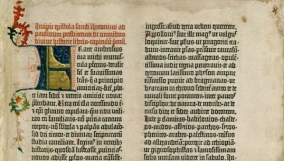
A few pages of a rare Gutenberg Bible are expected to fetch up to $700,000 at Sotheby's in New York next week.
The pages, the entire Book of Esther plus the end of Judith, the prologue of St Jerome to Esther, and the beginning of the first prologue of Jerome to Job, are part of what is known as the "Noble Fragment" copy of the Bible, one of 180 printed by Johann Gutenberg in Germany in the 1450s.
About 49 copies of the Bible are thought to survive today.
This copy is "handomely rubricated in red and blue" and got its name from its provenance when owned by Gabriel Wells, a dealer from New York, who in 1921 began selling off his bits of it page by page at $150 a time. He took the decision to do this because so many pages were already missing. Sotheby's described his approach as successful because it gained him great publicity. the New York Times commended him for spreading the Gospel "among the rich".
The eight-page section being auctioned next week was originally purchased by Mortimer Schiff for the Jewish seminary in New York which is now selling it through Sotheby's.
Rebecca Rego Barry wrote in Fine Books Magazine: "Single leaves of the famous 42-line Bible occasionally turn up at auction - one recently sold at Swann Galleries for $55,000 – but a complete copy hasn't been seen at auction since 1978, so this sizable section is estimated to make at least $500,000 for its consignor."
The catalogue desribes the fine script, "in red-blue interlock with pale green ink filigree, headlines of alternate red-blue lombards, chapter numbers of alternate red-blue elements, chapter initials alternately red and blue, red capital strokes, tituli to prologue to Esther, Esther, and first prologue to Job in red textura, following the printed rubrication guide issued with copies of the Gutenberg Bible."
The sale also includes A Edward Newton's accompanying essay, A Noble Fragment, of 1921.
The original Bible is thought to have arrived in New York via an unidentified convent or church, perhaps in Hesse, then went via the Court Library of Mannheim to the Royal Library of Munich and then to Robert Curzon, 1810-1870, 14th Baron Zouche (from 1870), then Mary Cecil Curzon Frankland, 1877-1965, 17th Baroness Zouche from 1917 and was sold via Sotheby's on November 1920, as lot 70 to Wells.
The catalogue describes it as from a first edition of the Bible in Latin, and the first substantial European printed book, produced under a temporary partnership between Johann Gutenberg, inventor of European typography, and Johann Fust, a well-off Mainz lawyer.
Production of the edition of more than 640 leaves of Royal folio size would have taken several years and a team of workmen.
The Gutenberg Bible presented only the black letter text, and spaces were left to be filled in by rubricators and illuminators according to the wishes of individual buyers in many different places. Every copy has therefore a different appearance.
The Book of Esther in Hebrew is the source text for the festival of Purim, held on 14-15 Adar, celebrating Esther's heroism in saving the Jews of Persia from annihilation in the reign of Ahasuerus, who was manipulated by an evil councillor, Haman, the catalogue says. The principle obligation of Purim is to read the Book of Esther, and there are many individual scrolls of Esther made for this purpose. No action of God is included in the story.