Does God give governments the right to wage war? Trump-supporting Rev Robert Jeffress thinks so; the pastor of First Baptist Church, Dallas was widely condemned for appearing to encourage the US president to nuke North Korea, saying 'God has endowed rulers with full power to use whatever means necessary – including war – to stop evil. God has given Trump authority to take out Kim Jong-Un.'
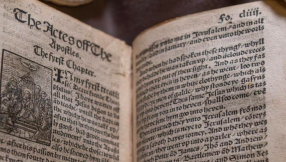
He's now said people overreacted to his statement; he was simply referring to Romans 13: 1-7, where Paul writes of the authority of rulers. 'The authorities that exist have been established by God,' he says, adding that 'he who rebels against the authority is rebelling against what God has instituted, and those who do so will bring judgment on themselves.'
Jeffress appears to have particularly in mind Paul's commendation of 'the one in authority': 'He is God's servant, an angel of wrath to bring punishment on the wrongdoer.'
A text like this, though, provides a prime example of how reading the Bible in a flat, literalistic way sometimes just doesn't work – and it its worst, it can be used to justify the most horrendous abuses.
The trouble is that there are so many 'authorities' that are godless, oppressive and just plain wicked. What does the Eritrean Christian roasting in a shipping container think about verse 3, 'For rulers hold no terror for those who do right, but for those who do wrong'? What about the Christians in Iraq and Syria terrorised by the authority of Islamic State?
And when Paul says, 'he who rebels against the authority is rebelling against what God has instituted', how do American Christians – whose national identity was forged in just such a rebellion against a legitimate authority – read that verse?
In fact, we understand very well that Paul is speaking into a particular situation, writing to Christians in Rome, the heart of the empire, which with all its savagery at least had some concept of the rule of law. There are other authorities, though, which are not godly but Satanic, and should be resisted. As Roundhead rebels in the English Civil War and American rebels in the War of Independence knew, the possession of authority is in itself no indication that it has been given by God. Authority is to be judged on how it's used, and whether the ruler is behaving justly.
So if authority is conditional, it can't be appealed to unconditionally. Rulers are judged too, by whether what they do meets God's standards. They can't oppress their people, they can't be corrupt, they can't sow division and hatred, they can't begin wars of conquest, they cannot torture or steal or lie. And there are no exceptions for the democratically elected leaders of enlightened Western countries, either: they are all under judgment.
And so appealing to Romans 13 to justify action against North Korea is problematic, to say the least. It implies that if Trump decides to go to war, it's right because he has decided it, and God has given him the authority to do so – and that just isn't true. It may – it just may – be necessary to fight a war in Korea, though it's very hard to find any strategist or diplomat who thinks so. But launching military action that isn't the absolute last resort would demonstrate more clearly than anything else that Trump is outside the will of God and that his 'authority' has been revoked.
Bad theology can be very dangerous when it emboldens the tyrant and the oppressor. It has to be challenged wherever we find it.
Follow Mark Woods on Twitter: @RevMarkWoods