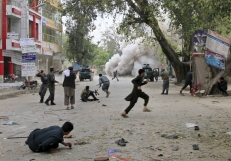
An Afghan judge sentenced four men to death yesterday for the mob killing of a 27-year-old woman accused of burning a Koran in Kabul, a case that sparked outrage and rare street protests against religious extremism in the capital.
The caretaker of a Muslim shrine who falsely accused the woman of desecrating Islam's holy book was among those sentenced to death.
Eight defendants were jailed for 16 years for participating in the attack in which a crowd beat and kicked the woman, named Farkhunda, and set her body on fire in central Kabul as bystanders chanted "God is great".
Judge Safiullah Mujadidi found 18 others not guilty due to lack of evidence.
The four men sentenced to death were convicted of murder, in part on the basis of mobile phone footage of the attack that was played in court during the five-day trial.
Some of those arrested were tracked down after posting footage of the attack on social media and bragging about taking part.
Nineteen police officers were also on trial, accused of standing by and doing nothing to stop the violence. Their verdicts and sentencing are due later in the week.
The attack proved a polarising incident in Afghanistan, a deeply conservative Muslim country. Initially, some clerics said the killing was a defence of Islam.
Many others were outraged by the attack, even before an investigation showed that Farkhunda had been falsely accused of desecrating Islam's holy book.
Farkhunda, who was a long-time student of Islam, had a running dispute with Zain-ul Abedeen, the caretaker of a local shrine, over his selling of amulets and other good luck charms. She considered the practice un-Islamic.
Apparently in retaliation, he publicly accused her on March 19 of burning a Koran and led the crowd that surrounded her and beat her to death.
Zain-ul Abedeen and the three others condemned to death can appeal against their sentences.
Several protests against religious extremism and violence against women sprung up in Kabul, including one in the last week that re-enacted the attack.
Such demonstrations are rare, even though women's rights were enshrined in the constitution after the Taliban's hard-line Islamist regime was ousted in 2001.
Under the Taliban's five-year rule, women were banned from leaving home without a male guardian, denied education and forced to wear the all-covering burqa.