Amid an escalating crackdown on churches in Cuba, a prominent pastor and religious freedom activist has warned that "the threat of physical violence... comes with the territory of being a Christian" in the Caribbean island.
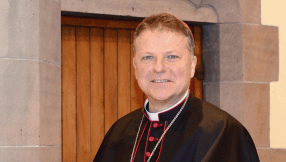
Rev Mario Felix Lleonart Barroso, who has left Cuba after being targeted by authorities, told International Christian Concern (ICC) that the Cuban government closely monitors religious groups.
The Office of Religious Affairs (ORA) is "supposed to mediate and act as a bridge between churches, people, and the government," he said.
"But if you've lived in Cuba or know anything about the way things are from the inside, you know the ORA is nothing more than an arm of the state established to suppress the religious liberties and rights of Cuban citizens. It's just another one of the government's ways to have eyes and ears everywhere."
The constitution guarantees religious freedom in Cuba, but UK-based Christian Solidarity Worldwide (CSW) has warned that the government's treatment of religious groups has significantly deteriorated in the last year. The organisation has accused authorities of targeting church properties "to tighten its control over the activities and membership of religious groups and thus eliminate the potential for any social unrest."
Between January and July 2016, CSW recorded 1,606 violations of religious freedom including the demolition and confiscation of church buildings, the destruction of church property and arbitrary detention.
Religious leaders have also had their personal belongings confiscated, and more than 1,000 churches are still considered 'illegal' and are under threat of future confiscation.
Barroso said the closure of churches and the eviction of members is "bad enough", but warned that there is also "the problem of destroying or even burning things inside the building; not to mention, the threat of physical violence that comes with the territory of being a Christian in Cuba".
He was arrested in March, just hours before US President Barack Obama arrived in Cuba for an official state visit. His wife was placed under house arrest and locked inside their home with the couple's two young daughters.
"It was one of those moment that you never forget," Barroso told ICC. "Knowing that your daughter is watching something like that is a painful experience. It's hard for a young mind to understand that expressing your beliefs and your opinion can land you in a jail call.
"You think to yourself: standing up for what is right could end up being the end of my life."
Despite the troubles, however, Barroso told ICC he remains hopeful about the future of the Church in Cuba.
"The reason the government sometimes tries to silence the Church or to close down church buildings is because it is worried about how many people are turning away from the state and looking to God (and the Church) for answers and for hope," he said.