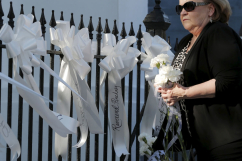
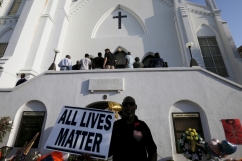
In the midst of mourning the nine victims gunned down at a historic African-American church in Charleston earlier this month, retired nurse Vickie Countryman found herself shopping for an upcoming wedding.
Her spirits were lifted by a black shop assistant at Dillard's department store, who cheerfully fussed over her and helped her find an outfit.
Countryman, 60, was stunned when she learned that one of the massacre victims was the assistant's cousin.
"Her parting words to me were: 'It's okay, we're going to be okay'," said Countryman.
"I'm standing there, white, and without words," she recalled.
The store employee's reassuring manner in the face of tragedy, was just one example of the extraordinary grace and courage of Charleston's black community, seemingly setting it apart from other US cities that have grappled lately with racial issues.
The deaths of the "Emanuel 9," shot while attending Bible study at their African Methodist Episcopal (AME) church, allegedly at the hands of a racially-motivated gunman, was an ugly reminder of the city's history as a key slave port and a hotbed of white supremacy.
Yet, the city's response to the horrifying murders - including the tearful forgiveness expressed by relatives of the victims during the accused gunman's first court appearance - also highlighted the profound ways Charleston, and to some extent the state of South Carolina, have changed since the civil rights movement of the 1960s.
The warmth and unity shown by the city in the face of tragedy, Charlestonians say, reflects two home-grown currents that run deep in the city: its world-renowned Southern charm and hospitality, and a deep-rooted religious faith.
"You put those together and what you have is Southern grace. That's what defines us. It's the way we were raised," said Tamara Curry, an African-American Charleston judge
Residents also cite strong local leadership, both pastoral and political, as well as recent economic progress in explaining their city's calm in a time of crisis.
To be sure, some black leaders question whether forgiving the slaughter in Charleston so quickly sent the wrong message, suggesting that the status quo is acceptable. But Charleston's faithful stand by their reaction.
"FAITH IS IN OUR DNA"
"Forgiveness has been a part of the African American struggle through all of the persecution, the attack dogs, the water hoses," said Rick Wade, a Charleston businessman and former campaign adviser for President Obama.
"We prayed and we forgave. We still do that today. You can't break that. Faith is in our DNA."
With a church on almost every street, and sometimes more than one, Charleston is known as "the Holy City." And no church is more holy than Emanuel, dubbed "Mother Emanuel,' founded in 1818 by freed slaves, almost half a century before slavery was formally abolished in the United States.
Funerals for the victims have been joyous gospel celebrations of life, known as "homegoings," where laughter triumphed over tears.
"The people of this church are extraordinary. They live like Christ lived," said Countryman as she stood in line for hours outside Emanuel on Thursday with her husband, a local surgeon, to pay her respects at Pinckney's wake. "I've never seen anything so authentic."
While the strength of Charleston's black church culture is not unique in America, the peaceful street scenes in Charleston stand out in sharp contrast to the violent clashes that erupted in Ferguson, Missouri, and Baltimore, Maryland in recent months after racially charged incidents involving the police.
Because the deaths in Charleston took place in a church, pastors naturally led the community response, said Donald Jones, a University of Miami constitutional law professor, who is black and was raised in Baltimore.
"In Ferguson and Baltimore the site of the atrocity was the street and you had a whole different set of voices and leaders," added Jones.
"This is not the world of the gangsters and the saggy pants," he said. "It's feels like a 21st century civil rights reawakening. They have risen above this toxic event. It's almost superhuman."
LEGACY OF SLAVERY
Half-a-century ago, Charleston was a very different place, with a white leadership that scorned modern ways, including racial integration.
City leaders then were openly proud of Charleston's leading role in the pro-slavery Confederacy during the 1860-1865 American Civil War. The city hosted the signing of South Carolina's formal secession from the United States. The war's first shot was fired at Fort Sumter in Charleston harbor. Even today, the city struggles to reconcile pride in its past with modern ways.
"It's so well preserved that we're constantly reminded of our history," said Gibbs Knotts a political scientist at the College of Charleston.
Among the area's tourist attractions, in addition to its well-preserved antebellum architecture, are the Old Slave Mart Museum and former plantations with landscaped gardens featuring original slave cabins."There have been calls recently saying we have gone too far in hailing the Confederate history." said Knotts. "We have to grapple with the past and what it means going forward."
But, history tours aside, much has changed. Once the most recalcitrant of Southern cities during the civil rights era, Charleston has become far more liberal.
In 2008, while Barack Obama lost South Carolina by an 11 percentage point margin (55-44), he took Charleston county by 2 percentage points (50-48).
Many credit local leaders, such as Pinckney, who was a state senator, for promoting racial tolerance and inclusiveness in the city of 130,000 which is 70 percent white and 25 percent black.
The city's famously long-serving mayor, Joe Riley, a 72-year-old white Democrat in office almost 40 years, has worked tirelessly on behalf of the black community. Early in his career whites derisively nicknamed him "Little black Joe."
Riley, now a fit-looking, white-haired man of 72, opened the doors of government to blacks, promoted neighborhood policing and fought to protect affordable housing in the city's historic downtown from a wave of gentrification that has pushed out less wealthy blacks.
"The only reason I ran for mayor was to build bridges of racial progress, respect and affection," Riley told Reuters on Sunday, as he prepared to attend another funeral at Emanuel, alongside Vice President Joseph Biden.
"In Charleston African Americans have the same felt ownership as other people," he said. "That's why we were ready for this."
Riley, who will step down at the end of his 10th term in December, called the massacre the "hardest, most heartbreaking" moment in his career. But it was also an uplifting "teaching moment," he said.
After attending Pinckney's funeral on Friday, at which President Obama spoke, Riley drove another five hours for the burial in rural South Carolina.
The mayor said he was heartened by the sight of people waiting to greet the family at a crossroads, "black and white people standing together waving the American flag."